Drag, Modern Dance, and REBIRTH
By Garth Grimball
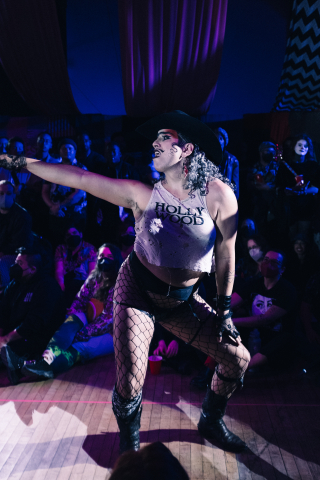
“Since I don’t have any pee, will someone spit in my mouth instead?” performer Hollow Eve requested midway through REBIRTH: The Death of Drag. Fellow castmates obliged.
On May 17-19 Oaklash celebrated its seventh year of bringing drag and queer performances to the Bay Area at venues in and surrounding downtown Oakland. Friday night kicked off with the O-SNAP! party at the Nectar Social Club; on Saturday Oaklash took over four blocks of Old Oakland with vendors and two stages, featuring recent Rupaul’s Drag Race winner Sasha Colby, followed by the Afterkii party at ForTheCulture; Sunday’s closing event at Omni Commons REBIRTH: The Death of Drag was billed as a funeral followed by performances.
Mama Celeste, one of the festival’s organizers, pitched coverage of REBIRTH as being more performance art-leaning than the rest of the programming. Color me intrigued. In 2022, I published a piece for Dance Stories on trends in the field. One trend being the influence of drag on modern dance, specifically the aesthetics and the theatricality of confidence. In the Bay Area there is a lot of crossover between drag and modern dance. Many of the performers lip syncing at the monthly Clutch the Pearls drag cabaret in San Francisco, you have likely also seen leaping, turning and partnering on sprung floors across the Bay.
After spending Saturday at the block party, both for pleasure and gearing up to write about a drag performance for LAAMD, I began to identify quartets of words like I was playing the NYTimes game Connections.
DRAG & MODERN DANCE COMMONALITIES
Reactionary Open Definition Big Tent Faces
Both drag and modern dance share an evolution with roots in the reactionary. The Mothers of Modern Dance (or THE Modern Dance as it was once known) were reacting against the aesthetics and tropes of ballet. Inherent in drag is a reaction to the gender construct and its prescribed and totalistic performances. As those reactions have refracted and iterated each form has become increasingly inclusive to the point of blurring a unified definition.
Modern dance is easier to describe as what it isn’t than what it is: it isn’t ballet, it isn’t hip hop, it isn’t folk dance, it isn’t performance art; yet it may incorporate any and all of those forms and more. As Rupaul says, “You’re born naked, you die naked, the rest is drag.” By that dictum drag is not exclusive to a specific type of gender commentary; it is inclusive of infinite transformations.
The multiplicity of styles and interpretations in each means both forms continue under a big tent. To the evolution of drag and modern dance diversity is necessary.
Re: Faces, modern dance and drag’s utilization of the face are opposite sides of the same coin. Modern dancers are (in)famous for their lack of facial expression in performance. Drag performers elevate the elasticity and expressiveness of the face to High Art.
All of this is to say that REBIRTH: The Death of Drag was a drag performance in equal parts reverent and anarchic. And within the performing of reverence and anarchy were commonalities with modern dance forms.
The installation and performance were a celebration of the life and death of Phatima Rude of the House of Rude, who died in 2021. The OMNI Commons was festooned with swaths of textiles and floating gates that resembled a circus tent meets the inside of Jeannie’s lamp from I Dream of Jeannie. An altar to Phatima Rude had four monitors each broadcasting unique footage from video of the artist to Pride parades past to gay pornography and John Waters films.
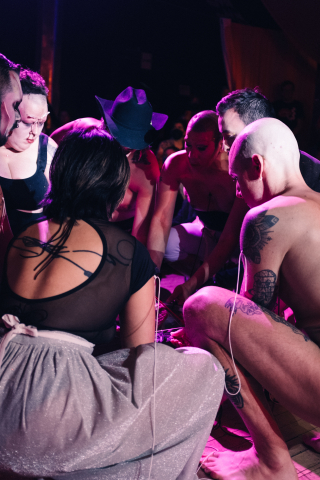
After Hollow Eve toasted Phatima in a sincere tribute, the audience was ushered into the inner sanctum of REBIRTH to witness a celebration brought to life by Hollow Eve, Jillian Gnarling, Kochina Rude, Pseuda, Aya Dapt, La Chucha, Krimm, Uphoria Glitter, Dvvsk, and Hollywood Texas. The ensemble began in a line of trios and duos; set to the melancholic “I’ll Be Your Mirror” by Nico and The Velvet Underground, each group held an empty frame through which one performer would put makeup on another. What followed was a deeply felt and sublimely irreverent melange of solo performances and interstitial group numbers.
Hollow Eve performed the first solo number to Bjork’s “Freefall.” It had a clarity that veered closer to elegy than camp as they contorted or held stillness on the runway. A delightful ping ponging between high-tech and low-tech followed. One transitional group scene had all the performers throwing balls of bright yellow yarn back and forth across the space creating a web. Solos became joyful dance parties. A leaf blower played a guest role. Pseuda took the audience into the future during their solo. Standing on a rotating platform uplit by black lighting, they had sci-fi looking gloves on that radiated light at each fingertip. When caressing their body each fingertip left green trails under the light.
In one of my favorite transition scenes the ensemble moved through the space as a kind of emotion train. The performers shuffled in a single file line saying “chug-a-chug-a-chug-a” until one by one each shouted out an emotion that they all embodied. Like a Viola Spolin theater game the simple task prompted a wealth of interpretations. As a celebration of an artist and an artform, every emotion and every interpretation was like a mini tribute to the robust and multifaceted art of drag.
Garth Grimball is a dance writer and artist based in Oakland, CA. He is a contributor to SF Examiner and Dance Media. He is the editor of ODC’s Dance Stories.

 Life as a Modern Dancer
Leave a comment