A Bed of One’s Own in Flyaway Productions’ If I Give You My Sorrows
By Garth Grimball
Opposites attract. But opposition alone thwarts attraction. To attract, to synthesize into something unique and fecund demands an openness. Flyaway Productions’ If I Give You My Sorrows, performed Jan 31 – Feb 2 at YBCA’s Forum, synthesized seemingly opposing form and content with an openness that led to deeper consideration.
From 2017-2023 Jo Kreiter’s aerial dance company created The Decarceration Trilogy: Dismantling the Prison Industrial Complex One Dance at a Time. This new work builds on the trilogy with an explicit focus on women in prison. At face value the form of aerial dance and the content of incarceration may seem too opposite to succeed. How can aerial dance, a form that frees the body from the constraints of gravity, address so totalizing an anti-freedom content as imprisonment? In If I Give You My Sorrows, Kreiter and collaborators synthesize this opposition in one object: a bed.
The program book includes the prose poem “My Bunkbed as an Antidote” by Tomiekia Johnson, who is currently experiencing incarceration at the Central California Women’s Facility. Johnson writes, “I’ve been giving it some thought about how the only door I can open in prison is an invisible one leading to my bunk bed.” The poem, in print and in voice over excerpted in the musical score by Carla Kihlstedt, Kalyn Harewood and Pamela Z, is the entry point and focal point of the production.
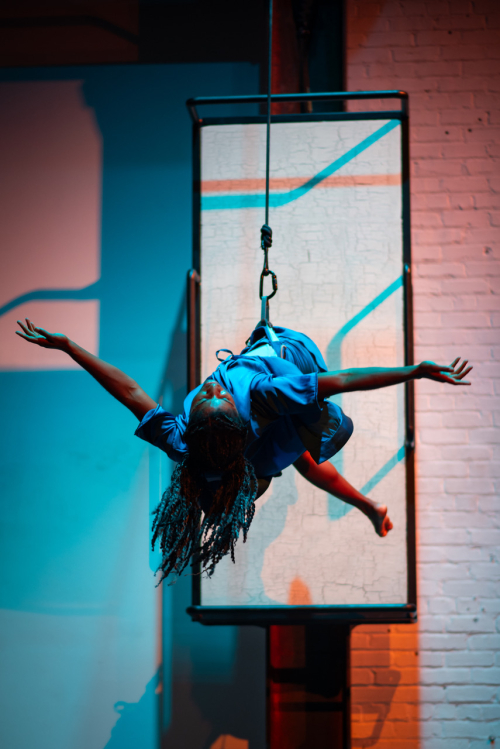
Matt Antaky lit the YBCA Forum space in cool hues that ranged in intensity. Set designer Sean Riley created bare, almost brutalist, bed frames of varying sizes, several remained upstage and others served as vertical ladders or were lifted swinging into the air like a cradle for safekeeping or a pendulum relentlessly measuring time.
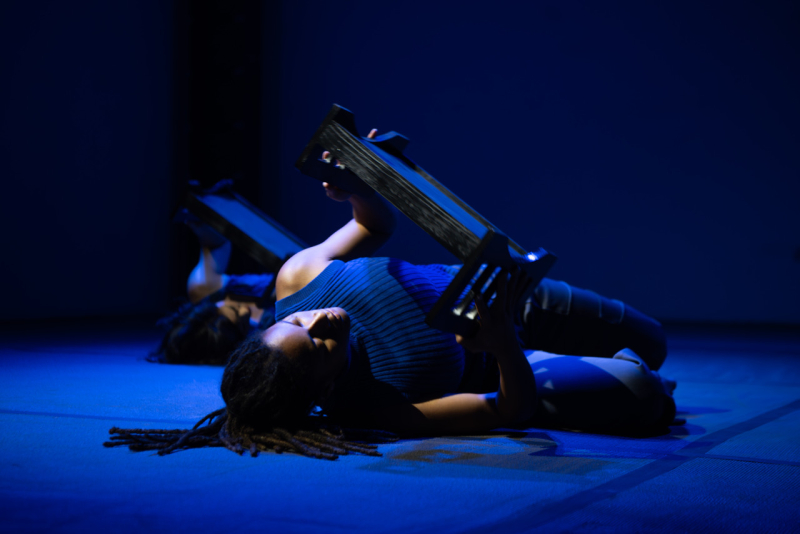
If I Give You My Sorrows has seven discrete sections and the cast of six dancers progressively unbound themselves from gravity as it developed. Dressed in blue separates, the dancers entered with miniature models of the bed frames, moving them around their bodies, in control of their relationships to the object. Jhia Jackson climbed onto an elevated bed frame that faced the audience so it looked like she was lying down as she was standing up. Megan Lowe and Sonsherée Giles wove themselves into the elevated catwalk’s railing. The viney, shifty choreography contorted the bodies in their restless efforts to fit and find comfort.
Later, the beds became islands of solace when Jackson, Giles and natalya janay shoaf abstracted the meeting of prayerful hands into swipes and reaches, or, when MaryStarr Hope was swinging through the air on the rigged bed platform in convulsions evocative of labor pains.
The movement vocabulary was limited by the restraints of the form—rigging, harnesses, set pieces—but within the conceptual container it is a feature not a bug. The limited movement and the isolation of the dancers reinforced the physical realities of incarceration. In the final section the whole cast ran in waves through the space, diving under the swinging bed platform, leaping onto it, rolling off it, weightless for milliseconds. The voice over returned: “My weaknesses get ironed out up here.” If I Give You My Sorrows invited the audience to see a familiar object in greater detail, to consider people experiencing incarceration with openness, not opposition.
Garth Grimball is a dance writer and artist based in Oakland, CA. He is a contributor to SF Examiner and Dance Media. He is the editor of ODC’s Dance Stories.

 Life as a Modern Dancer
Leave a comment