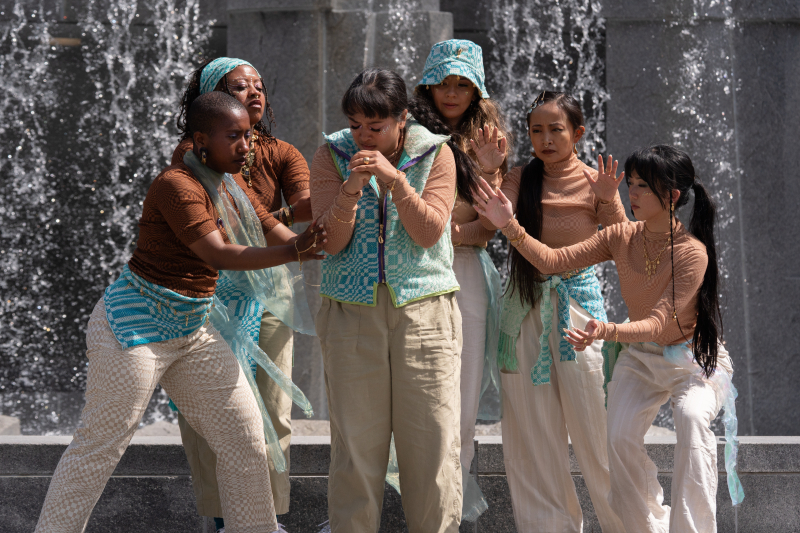
spiraling at the party with SAMMAY Peñaflor Dizon
By Bhumi B Patel
It was a beautiful sunny day in San Francisco and the crowd on the Great Lawn of Yerba Buena Gardens was buzzing. Friends connected with friends, YBGF staff handed out festival calendars, and everyone, sprawled across the grass and a few chairs, waited with anticipation for the beginning of SAMMAY Productions’ “the way home is an upwards spiral” to begin. SAMMAY Peñaflor Dizon, choreographer and director of the work, was welcomed to the space with an uproar of cheers and shouts. She spoke gratitude into the space, saying quite aptly that “this performance is our lives,” blurring the boundaries between what was “the show” and what was “not the show,” and before I knew it, we were in it. An adorned mirror was a portal to a visit from a performer’s “baby me,” whom she spoke to into the mic so that we could be with this intimate moment of self connection. I was drawn into a landscape of daydreaming otherwise. This intimate sensation of being inside a dream carried all the way to the end of the piece, which was punctuated by a dance party in which audience members were welcomed to get groovy and dance the “filipino cha cha” joyfully with one another.
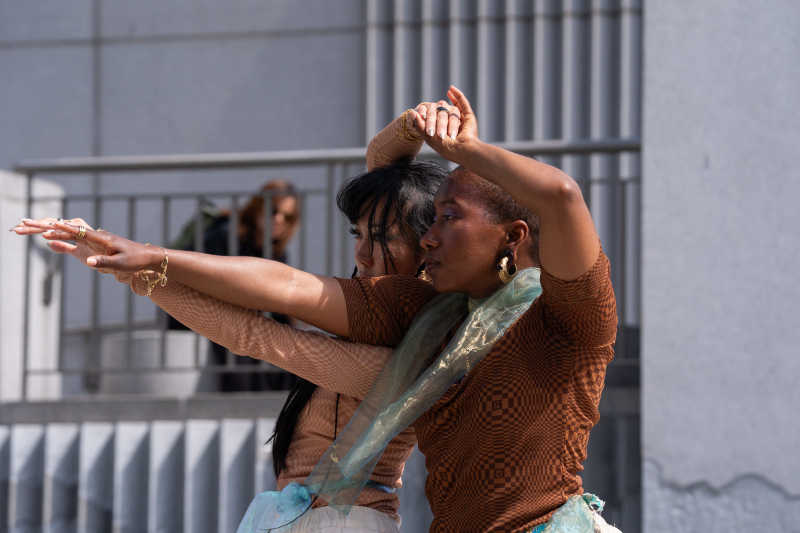
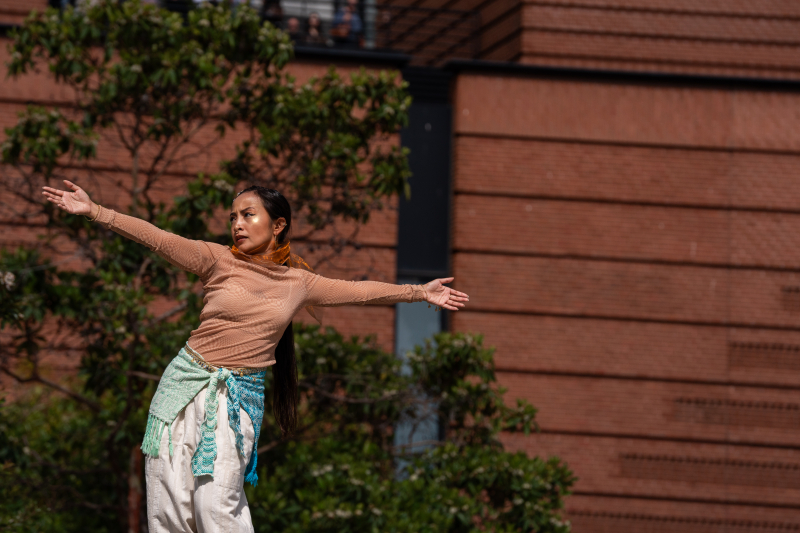
Performances like this one are “more than a rehearsal for the example of a better world. It is a reparative practice through which we keep our dead alive and through which we pull ourselves together enough to weather the storm another night so we can sustain the fight the morning after” (Chambers-Letson). The site-responsive work moved through four locations at Yerba Buena Gardens– the reflection pond, waterfall, east wall, and east garden – where performers Poko Devis, Cece Egidi, Danielle Galvez, Amber Julian, Laila Shabazz, Vi Vu, and SAMMAY herself allowed us into their “rehearsal for a better world” through acts of tenderness and transformation, boundary-pushing and battle, rest and resistance in order to change the world. As we traveled from site to site with the undercurrent of sound designed by JoJo Ramirez, Josh Icban, and DJ Utak, I found myself witnessing the ways that we weather the storm: a tender touch between two performers, fists pressed to the side of one performer's own head, the waving of a fan as long fabric billows in the wind, performers and audience members posing in a makeshift photobooth, a booty shake. At the waterfall, we flowed softly through each section, with dancers observing one another in their solo, duet, and trio groupings. At fleeting moments the whole group came together in delicious flow – whether it was in front of the waterfall where they swam through the air in contemplative soft phrases or in the east garden where they energetically cha cha’d in pairs light with the devotional practice of connection. Each moment of the piece flowed into the next imploring those of us in the audience to imagine alongside the performers what other worlds are possible.
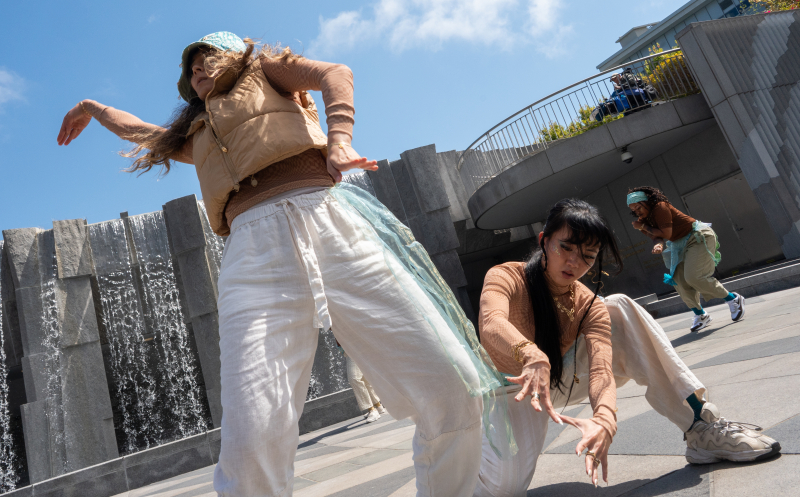
As I reflect on the performance now, days later, it is the last section of the piece in the east garden that sticks with me the most: we gathered to watch the performers watch themselves once again through that mirror-portal that we saw at the beginning of the piece. As performers peered at themselves, audience members were invited to participate in a party and it might seem that the joyful party is the antithesis to what we need at this moment of rupture across the globe, but in truth, it is exactly what we need. In the program note, Dizon writes, “Nothing we do is frivolous. In a time where our nation’s so-called leaders are using every tactic in the book — our choosing to stay in our bodies and in relation to one another is nothing short of a radical act. Our joy is our resistance. Our rest is our birthright. Our pleasure will be prioritized” and I started thinking about how for many queer people, “the party” (or maybe “the performance”) acts as a rehearsal for liberation, community, and political action. This performance work lands on me (from my position as a queer of color artist myself) as a queer of color critique of so many of the oppressive forces that impact our lives grounded in street dance forms and Filipinx heritage to create a party that, as Joshua Chambers-Letson writes, “is as much a site of refuge as it is the site of revolutionary planning” because “the party, as refuge, is a place to catch one’s breath when you can’t breathe.” The movement vocabulary for the piece challenges and expands both the genres of street dance forms and Western concert form, with traces of whacking, vogueing, contemporary dance, popping, krumping, and house braiding together a devotional practice that left me asking myself where I locate “home” in the most capacious sense of the word.
Perhaps home is the party – the site where we can find refuge, joy, connection, and the camaraderie and community to act toward our own liberation. To me, the piece ends as it began, a kind of uncertain continuity blurring the edges of life and performance into the imaginings and enactments of new entanglements that birth new ways of surviving the world.
Dr. Bhumi B Patel (she/they) is a queer home-seeker and science fiction choreographer, director of pateldanceworks, and writer. Patel tends to her desires to create liberatory, nourishing community spaces through dancing, choreographing, curating, teaching, and scholarship and has presented her scholarly and performance work nationally and internationally. Patel serves as Editorial Assistant for Choreographic Practices and teaches dance practice and dance studies in higher education. Bhumi’s research on queer decoloniality and improvisation intersects with her performance-making as a way of tracing the deep connections of past, present, future to build communities of nourishment and care.

 Life as a Modern Dancer
Leave a comment