Age of Content Captures The Rot And The Joy Of Being Online
By Garth Grimball
Straight out of the gate: Age of Content ruled. I can’t remember the last time I saw a dance that wedded concept to execution at this scale and with such verve.
Created in 2023 by (LA)HORDE, the trio of artists who took over the direction of the Ballet national de Marseille in 2019, Age of Content was performed at the Howard Gilman Opera House at BAM on Feb 20-22 as part of the Van Cleef & Arpels Dance Reflections festival. The work has three distinct sections but each spoke to online (un)reality in ways specific and broad enough to be absorbing and not didactic.
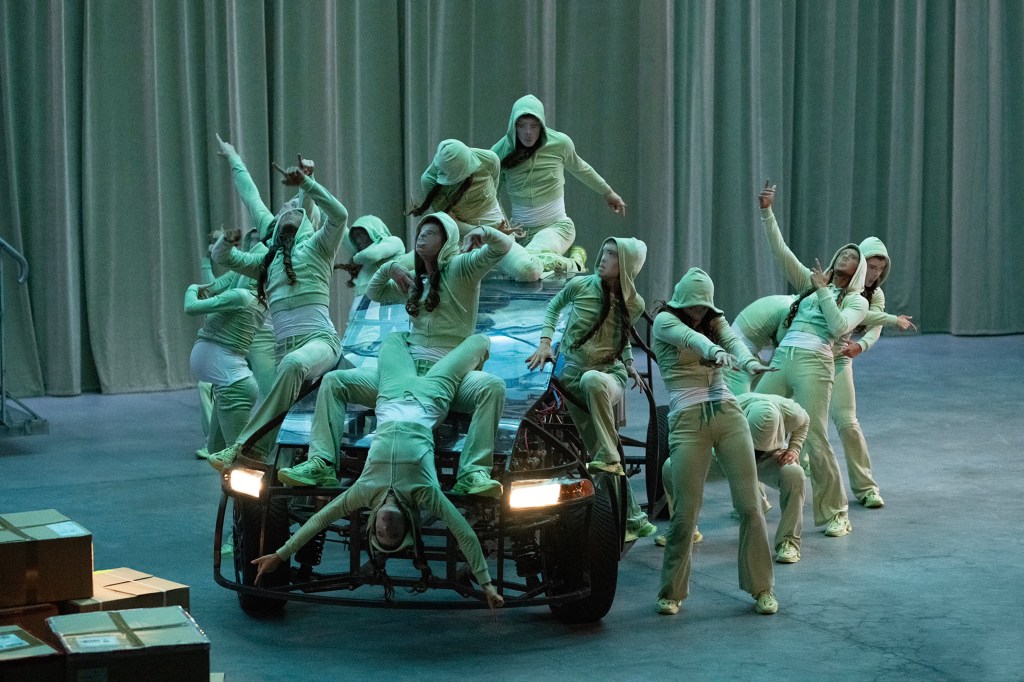
The stage was transformed into a fulfillment factory. Metal stairs led to an elevated platform on stage right. Under the platform was a mound of stacked cardboard boxes. A grey-green curtain was drawn across the back with the front half of a car, draped in the same color fabric, peaking out. A bald man walked onto the platform. Dressed in a red t-shirt, jeans and sneakers with headphones around his neck, his presence felt like an absence, emotionless. He pulled a handheld remote out of his pocket and the headlights of the car turned on. Slowly the car emerged out of its draping. It was an actual remote-controlled vehicle the size of a real, functioning car. Its exterior parts were transparent so the mechanics were visible. The car slowly paraded around the stage.
A figure slipped out from under the curtain. Highly visible yet anonymous, they wore a light green Juicy Couture track suit with the hood over their head. Braids draped over their shoulders and a mesh mask covered their face. This emblem of early 2000s fashion leapt onto the moving car and proceeded to writhe over it in a sensual pas de deux. Eventually the controller activated hydraulics that bumped the figure off the car. More people entered the factory, in the same track suits, braids and masks, a small, Juicy gang.
They fought amongst themselves for dominance of the car. Dancers tossed each other on and off the moving vehicle, the hydraulics threw them off mid squabble. Occasionally one or two would look up to the controller, threatening him with punches into the air. Moments of collective action burst through the infighting. A unison phrase of fast-paced angular gestures sent an energy of refusal to the unbothered baron. Disruption of this particular matrix be damned; the Juicy gang writhed over the car or squared up against each other as the sleek tech drove them behind the curtain and the controller exited unmoved by the effects of his creation.
The factory stilled. A mass dropped from the sky onto the floor behind the trove of boxes. Out popped a woman. Her movements were limited but constant. It was soon clear that she was moving like video game characters of the early 2000s (Grand Theft Auto and Sims). A man entered while she explored the space. He too wore a red t-shirt, jeans and sneakers. But he sported a middle part bowl cut, and his shirt was cropped and his jeans were so low-rise the upper half of his butt cheeks were exposed. Did we enter the controller’s game? Is this man his avatar?
More characters emerged. It was thrilling to see how they maintained the video game movement quality: awkward heel-toe walks, hitting a barrier and running in place until turned by an outside force, bouncing up and down waiting to be directed, arms always slightly tensed. Most impressive was the blank stare into nothingness. The dancers as digital avatars moved through tightly choreographed interactions that required incredible timing and they never dropped the dead-eyed presence of thoughtless vessels.
The curtain was pulled back to reveal deep shadows, red light and billowing masses evoking a mushroom cloud. The avatars withdrew from their tasks and dispersed. When some of them re-emerged the movement quality shifted into a prurient nature. In 2020, it was estimated that 12% of all websites were pornographic. Age of Content showed physical bonds that were sexual but never perverse, provoking the question, is it possible to think of sexual acts without the influence of pornography?
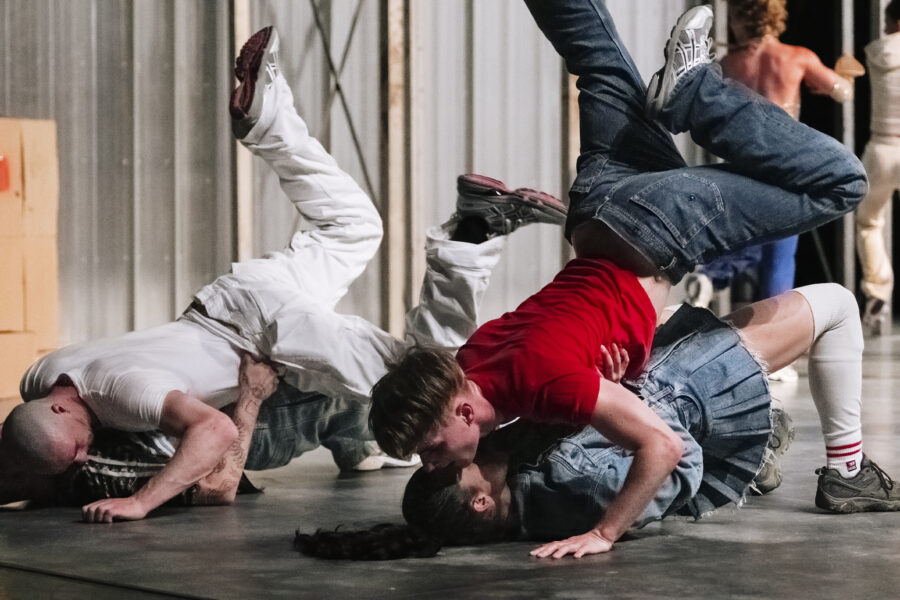
The red-shirted avatar was joined by 5 other characters in a menage of grinding, gyrating, body rolling, booty popping partnering and floorwork. One especially memorable motif had one dancer bent over back to the audience, hips high and hand on the floor bouncing back and forth from one leg to the other. Another dancer then bent forward and rested their head on the crest of the pelvis, so it looked like a body absent a neck and torso. A head bobbing on legs. Dancers bounced up and down into front splits and their partners pushed on their hips as if bouncing a basketball.
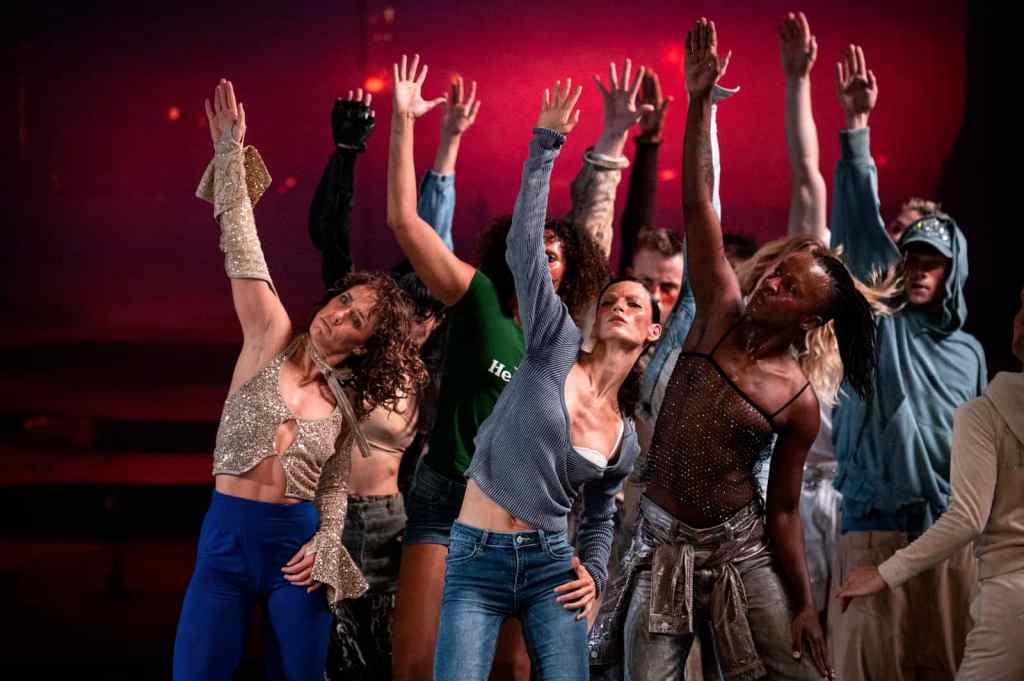
The curtain was drawn. Philip Glass began to play. The choreography started in reference to other Glass ballets. Dancers processed in a single-file line across the upstage a la Jerome Robbins’s Glass Pieces. A soloist entered in a flurry of small leaps evoking Lucinda Childs. But the choreography shifted into a different gear like scrolling from one piece of content to another. On the internet tonal shifts evolved into algorithmic tunnels, and the dancers led us joyfully down this one. The jazz funk style cemented by music videos of millennial boybands and pop girls took over. The full company took the stage in incendiary combos of isolations, twerking, and TikTok dances. The energy ratcheted up to ecstasy. Collective shouts broke through Glass’s arpeggios. The dancers ate up the stage in overlapping formations. When everything stopped it felt like time had to catch up with the energetic velocity. Age of Content bridged the digital divide in its theatrical worlds. The choreography and performances were so attuned to the frequencies of online spaces that it felt like an extension of the digital, not a facsimile of internet forums as performances about this age of content frequently become. This is peak creativity. Concept and form equally and terrifically matched.
Garth Grimball is a writer and dancer based in Oakland. He is a regular contributor to Dance Media and SF Examiner/Nob Hill Gazette. He is the editor of ODC Dance Stories.

 Life as a Modern Dancer
Leave a comment