La Playa
Olga Rabetskaya / OR Works
New York Live Arts, February 19-20, 2026
It’s Too Late to Visit “La Playa”
By Garth Grimball
How seriously can you react to a perilous warning when the warnings are so frequent they become mundane? In La Playa, from Olga Rabetskaya / OR Works, warnings of impending climate disaster take the backseat to interpersonal conflicts—humans gonna be humans—until it’s too late.
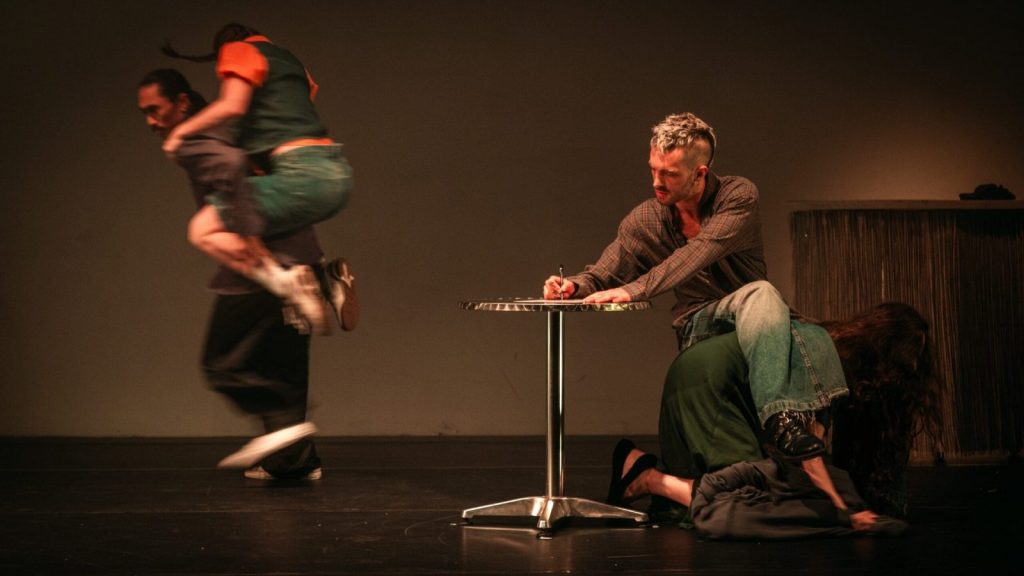
Rabetskaya and set designer Mario Marquez created a beachside resort in the New York Live Arts theater. A lifeguard stand, a bar and a café table, and an abstracted boulder covered in ship lines invited the audience to La Playa. Before the curtain speech, a woman in a bathing suit and towel sat at the base of the lifeguard stand with her back to the audience listening to an old portable radio. Another woman scrubbed the floor. Fog filled the space and an empty trash bag blew across the stage. A man entered, smoking, and threw the trash away. He was quickly joined by another man behind the bar and a woman with a basket of produce. This quartet served as elemental allegories: a cook/fire (Carl Ponce Cubero; a smoking waiter/air (Lavy); a cleaning lady/water (Emma Weiss); a gardener/earth (Elliana Lynch-Daniels). The woman with the radio didn’t interact with the foursome.
Once the characters were introduced the choreography settled into brief solos that led to partnering variations. Weiss’s vocabulary started as very balletic, Lynch-Daniels skipped a lot, Lavy slammed his fists down on tables, and Cubero slid around them all. The partnering had a conflicted tone like the characters were allergic to agreement. One would pull another. Two ignored a third. A quarrel would interrupt a character trying to ignore the others. The sound score of waves crashing was interrupted with PSAs warning that a tsunami was imminent. The quartet paid no mind, too busy with their own wants and refusals.
The tsunami hits. The lifeguard stand collapsed with a bang. The stage lights sent a blinding white light at the audience. When the event finished all that remained was the boulder, now surrounded by refuse.
The second half of La Playa left narrative for what Rabetskaya described as a “movement-driven celebration of the body.” The dancers were joined by musicians—Uyanga Bold, Josh Geisler, Igor Bagdagyulyan, Masha Vasilevskaya—who brought a sophisticated orchestration of polyrhythms, rounds, vocal modulations. The quartet returned and laid down on beach towels. Micromovements evolved into floorwork energy passing a la 90s rave dancing. Ponce stood and rubbed soil on their bare torso. Weiss dipped her mane in a bowl of water. The sound of a primate scream set the dancers to big dance phrases.
Attitude turns and leaps slowed to contact improv-esque partnering. At one point they collapsed to the floor and each took a turn pulling their weight onto and over the other like you would climb out of the water and onto a raft. In the final moments the musicians brought in club beats and the choreography quoted vogue and gaga styles. La Playa succeeded in its depiction of humans choosing individual ego over collective action. Its choreography lacked cohesion to sustain its ideas via dance. The choreography is credited to Rabetskaya with the dancers, and it felt like much of the vocabulary was created in response to prompts (e.g. make a phrase based on water) that needed greater direction, so that individual movement ideas could become a coherent whole.
Garth Grimball is a writer and dancer based in Oakland, CA. He is a regular contributor to Dance Media and SF Examiner/Nob Hill Gazette. He is the editor of ODC Dance Stories.

 Life as a Modern Dancer
Leave a comment