
Photo: Danielle Arico
Hometown: Allendale, New Jersey
Current city: Las Vegas, Nevada
Age: 39
College and degree: University of Utah, Bachelor of Arts in Biology (1995)
Graduate school and degree: Columbia University, Doctorate in Physical Therapy; University of Utah, Master of Arts in Modern Dance with an emphasis in kinesiology
How you pay the bills: I have always paid the bills with income from either working as a performer, teacher, or as a physical therapist.
All of the dance hats you wear: Every job that I have had revolves around movement, either as a performer/dancer, choreographer, guest faculty of dance, or as a physical therapist. The work I did with Cirque du Soleil was character work that drew upon dance, acting, and acrobatics. For this reason I often use the word "performer" instead of dancer.
Non-dance work you do: I have been a licensed physical therapist since 2004, but it is only in the last 2 years that I have supported myself as a therapist. Performing has been my primary means of income since graduating from the University of Utah in 1997.
——————–
Describe your first 5 years post-college:
The first year after graduation, I spent it teaching at the University of Utah. My mentor went on sabbatical, and I was hired to cover part of her course load. The next years were completely committed to working with Momix. Eating, drinking, breathing and bleeding for Momix. As a member I learned repertory, assisted in the creation of new work, and performed. But I also built shipping crates, organized the warehouse, and developed props.
I would occasionally pick up work with Pilobolus for special gigs. This ranged from a 6 week trip to Sardinia to perform in The Magic Flute, to performing for corporate gigs including the launch of the Pearl Tampon.
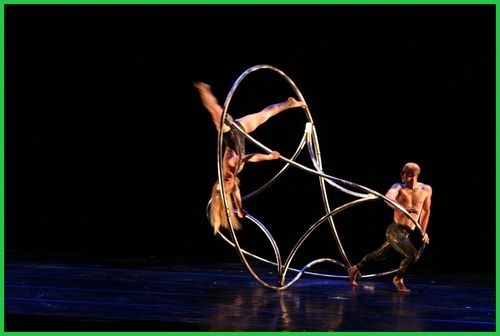
Craig Berman, right
Describe the first 10 years post-college:
In 2002, I thought that the best of my dance career was behind me, so I enrolled in a program for physical therapy. I earned my Doctorate in Physical Therapy and started a “regular” job. I only made it about 3 months as a therapist before I ran off and joined the circus. No, I didn't hate life as a therapist, but when I was recruited to be a creating cast member of a Cirque du Soleil show, I couldn't resist returning to the stage. I then worked with Cirque du Soleil from 2005 until 2010 as a performer on The Beatles LOVE by Cirque du Soleil as well as a choreographer of a backup act for the show entitled TOTEM.
Describe your dancing life in your 30s:
The majority of my thirties was spent with Cirque du Soleil. I really enjoyed my colleagues, but once the show was up and running there was very little variation; we did approximately 487 shows per year. Special projects provided the majority of the creative stimulation, including a performance at the 2008 Grammy Awards, choreographing for numerous in-house caberets, and finding a life outside of work for the first time in my life.
Performing so many shows a year can sap your creativity and challenge your artistic integrity. In order to keep the show from feeling boring, I would often dedicate the show to a friend, and to further develop my character I would add a new movement or gesture every week.
A turning point:
Life beyond dance. When I performed with Momix, everything else in life was put on hold, but when I performed with Cirque du Soleil my life was much more complete. With Cirque I had a stable job with a regular schedule and salary. I was able to enjoy a very nice apartment and resume my childhood love of rock climbing.
How did you land your various gigs? (Auditions, being seen in class, taking a workshop, etc?)
Personality is key. Showing that you are a talented dancer, creative individual, and a fun personality are all key. It is important to be able to laugh at yourself. I believe that it is more important to be memorable than to be technically perfect.
For Momix, I had an extended private audition. This audition seemed to last for the first 6 months. Making yourself valuable to the company by learning repertory independently and being available on short notice were key.
Cirque du Soleil invited me to a private audition in Montreal along with about a dozen other men. At Cirque, once they have seen all of your best tricks, they will sometimes ask you to do something outside of your skill set just to see how you respond. They asked me to show them a drag queen. After all of my sweating, jumping and rolling on the floor for the past 3 days, it was a silly striptease/ drag queen improvisation that landed me the job.
Major influences and mentors/someone who believed in you:
I started dancing in college. I did not have a whole lot of direction but a few people believed in me and provided guidance. It started with a girl in college who introduced me to Dr. Sally Fitt.
The late Sally Fitt (professor at the University of Utah) and the late John Wolken (founding member of Pilobolus) taught me to develop my strengths and trust my intuition.
Moses Pendleton (founding member of Pilobolus and Momix), Brian Sanders (Faculty at University of the Arts, and JUNK), and Stephen Brown (Founder of SB dance) are among the most creative influences with regards to the use of props.
Dance superstars Josh Larson, John Beasant, and Pi Keohavong taught me how to be an athletic and artistic male dancer, as well as to laugh at myself, and unleash creativity.
Luck:
I moved to NYC following graduate school in Utah. The very first night that I was in NYC, I went to a dance concert to see a fellow Utah alum perform. By chance I saw an old acquaintance in the audience, a fellow named Pi who I had met years earlier at an Erick Hawkins workshop. It turned out that Pi was dancing with Momix, my dream company. Later that week Pi spoke with the director of Momix and arranged a private audition for me. I then went on to work with Momix for 6 years. I performed throughout Europe and America and assisted in the creation of numerous full length works. Would I have had the same opportunities had I not gone to that show and randomly bumped into Pi?
On teaching:
Following my time with Cirque du Soleil I taught at the University of Utah for a semester. I had the fortune to teach the course once taught and developed by my mentor, Dr. Sally Fitt. I was later offered a full-time tenured track position at another university, however the logistics did not work out and I decided to return to Las Vegas and work as a physical therapist and climb in the surrounding mountains.
Current passions:
I have been passionate about rock climbing ever since I was a teenager. While I was in Momix I put climbing to the side and focused all of my attention and physical strength to Momix. However, I rediscovered my love of climbing when I joined Cirque du Soleil. My schedule and location in Las Vegas allowed me to take my climbing to new levels. I am now a top ranked climber in the old man category (35 years and older). The movement components of dance and climbing are very similar to me, however when I climb I do not have a boss supervising my performance. With climbing I get to travel to spectacular places and spend time outside with people I love, specifically my greatest climbing partner and wife Myranda.
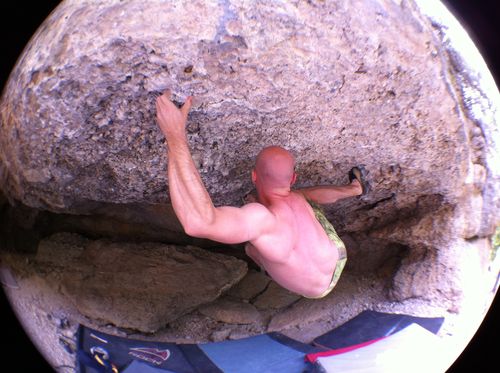
Photo: Myranda Bair
Current curiosities:
If I did not need to earn a living, I would be very happy designing playgrounds for both children and adults, as well as funky furniture, bridges, and buildings.
Training:
Once I left the University of Utah I did very little training outside of work. A typical Momix rehearsal day went as follows: 10:00- 11:45 ballet class, 12:00-7:00 rehearsal with 1 hour for lunch. At the end of the day I would be so wiped out that resting was far more important than training. With both Momix and Cirque du Soleil, technical training specific to your routines was built into your schedule.
Balancing your PT life/career and your dance life/career:
I have always had difficulty with multitasking. I generally focus on one thing at a time.
Failure:
I went to a lot of auditions and didn't make the cut, but when I found a community of people that shared my artistic and physical philosophy, everything clicked and my creativity and career blossomed.
Books, websites, blogs, and shows that serve as inspiration:
I am fortunate to have a number of creative friends. I am always watching their promo reels and recent choreography including dandypunk (mix of animation, breakdance, laser, props, and breaking gravity), sbdance, Pilobolus, Momix, Brian Sanders JUNK, and 4dart.
Advice to young dancers - Craig's Top 10 List:
10. Side projects are a great way to keep up your psych.
9. You will have good days and bad days. Make sure you have more good ones than bad ones. If not, change something.
8. Always have food with you. I always keep a Clif Bar in my backpack.
7. Try to work with people that you like, not just choreography that you like.
6. Learn from your mistakes and don't let your boss ever hear you complain.
5. Against the advice of many of my past teachers, I recommend that you focus on your strengths not you weaknesses.
4.Take chances.
3. At an audition, show personality not just technique.
2. Be willing to laugh at yourself.
1. Friendship and family are #1 for your success and happiness.


 Life as a Modern Dancer
Leave a reply to Alison Ribellino Cancel reply