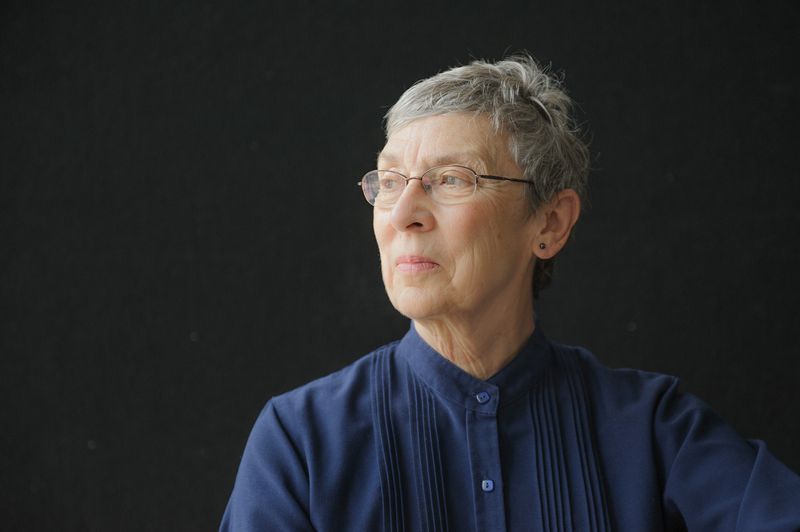
Hometown: Salt Lake City, Utah
Current city: Salt Lake City, Utah
Age: 74
College and degree: BFA in Modern Dance, University of Utah
Website: www.rdtutah.org
How you pay the bills: I am Executive/Artistic Director of Repertory Dance Theatre
All of the dance hats you wear: I direct, teach, lecture, perform, write, fundraise, organize and administrate
Non-dance work you do: I renovate old houses and walk my three dogs
————————–
I had a wonderful introduction to dance at a very early age.
I was born in 1940 on the eve of WW II. My mother saw an article in the newspaper stating that Virginia Tanner was offering creative dance classes for children. She enrolled me in a class taught by “Miss Virginia” held at the McCune School of Music and Art. When you walked in the door of this elegant mansion, you heard a collage of sounds…musicians practicing their scales and opera singers warming up their voices. It was a magical place.
Miss Virginia didn’t teach me a dance. She helped me discover my own dance…one that was inside of me waiting to blossom. She showed me how energy could flow through my spine, open my back and arms, and surge out of every pore in my body. She helped me open my eyes and mind and guided me to understand the connection between nature, movement and self. Dancing helped me understand how the sun could coax a seed to push through the soil, stretch toward the sky and wave in the wind before returning to the earth. Together the class created choreography inspired by the life cycle and my young body tried to embody the spirit of wheat. I was hooked for life. I had found my spiritual center at age four. I spent the next fourteen years developing my craft, performing, choreographing and being introduced to inspiring artists including Helen Tamiris, Doris Humphrey, Martha Graham, José Limón and Merce Cunningham. They are the ghosts that remind me what I need to do…every day.
My 20s:
At age 21, I was invited to join the José Limón Dance Company but decided to finish my college degree. I graduated from the University of Utah in 1964. And then, in 1966, when I was 25, an amazing thing happened. I got a phone call from the Rockefeller Foundation. They invited me to be part of an artistic experiment to help decentralize the arts in America. They wanted to fund a professional dance company dedicated to preserving American dance classics while nurturing new choreography. They thought that dancers should be paid a “living” wage. This was an unbelievable opportunity. I was invited to become a charter member of Repertory Dance Theatre in Salt Lake City, Utah.
30s:
The 1970s were a time of political upheaval, the Vietnam War, a social/sexual revolution, and an artistic revolution. As an RDT dancer in the 1970s, I had a full-time job performing, teaching, and choreographing. The NEA, a new national agency dedicated to the arts, was funding touring and Arts-In-Education initiatives. RDT was on the ground floor of developing outreach/community residency activities. We toured one third of the year traveling to communities large and small all over the U.S. I was given more and more opportunities to administrate, to write and narrate Lecture Demonstrations, to develop AIE activities, to choreograph and work with amazing choreographers including…Anna Sokolow, Douglas Dunn, Viola Faber, John Butler, and Glen Tetley. Modern dance was going through a renaissance.
40s:
In the 1980s, RDT concentrated on developing a “living” historic library of classic dance works. An NEA grant enabled the company to produce “Then…The Early Years” a narrated concert which focused on modern dance created in the first 50 years of the 20th century…Duncan, Shawn, St Denis, Humphrey, Weidman, Holm, Tamiris, Horton. What an amazing learning experience! I became Artistic Director of RDT at age 43. I was still dancing full-time, raising a son, and accepting more and more administrative responsibilities.
50s:
The 1990s offered the challenge of finding a new home for RDT. Hundreds of hours were spent doing feasibility studies, scheduling meetings, gathering information and raising consciousness about the need for alternative performing and rehearsal space for small and mid-sized performing companies in Salt Lake City.
After almost 15 years of work, my dream came true and RDT moved into its new home, the Rose Wagner Performing Arts Center. Two European Tours were icing on the cake. Still dancing but taking on the roles suited to a “mature" body and roles that required less jumping.
60s:
In my 60s, my performing opportunities were more limited to cameo appearances. My life was laced with lots of administrating, organizing, fundraising, grant writing, and worrying about the environment and society. National funding was shrinking, competition exploding in a changing market for “live” dance. I still loved the work. You have to endure challenges and changes…a different kind of creativity was needed to help dance survive. I tried to find ways for dance to play a more relevant part of community life. I gravitated toward community-building activities and found ways to use dance to help address social and environmental issues. Dance should be part of the solution, not part of the problem.
70s:
Now, in my 70s, I’m about to celebrate 50 years with RDT. Wonder where the time went? Challenged by technology and frustrated with society, I still believe in the power of dance and know with certainty that the arts are essential in the life of a healthy community. People sometimes ask when I’m going to retire…as if my life in dance was a job. Dance is a way of life, a gift, and a glorious responsibility. That is what the dance ghosts keep reminding me.
Can you describe a few of the biggest changes in modern dance over the span of your career?
- When RDT was founded, there were only about 150 “professional” dance companies in the U.S. This included modern, ballet, tap, jazz, ballroom, folk and you name it.
- In 1966, when you wanted to record a dance, you raised the money to have it filmed. No video then. Used records and reel to reel tape recorders.
- In 1966, RDT was one of the very few companies in the U.S. that offered dancers a “living” wage…some things never change.
What skills (attributes) do you think a modern dancer needs in 2015?
Patience and tenacity. Forgiveness and flexibility. Be open to the “new” and respect the “old.” You can’t do it alone. Find wonderful and dedicated people to help you achieve artistic success.
What do you look for a dancer?
I look for:
- Educated dancers and prefer they have a college degree.
- Experience and training in a variety of dance languages.
- Strong, clean technique. Because we are a repertory company, we need dancers that can jump, turn and stand on one leg.
- Disciplined, focused, curious and sane dancers with a healthy mind and body.
- Self-motivated dancers.
- Dancers who love team-work, can take criticism and leave their egos at the door.
- Dancers who understand that performing for K-6 graders in a school cafeteria is just as important as performing in legitimate theaters.
- Dancers with generosity and respect for fellow workers.
- With real passion for the art form and an openness to new ideas.
- I look for a “special” quality. Lots of dancers today have technique, but I need to see how they are unique. Dancers need to connect to their inner power and show me their fire, their hunger to move, their wit and creativity.
- I want a dancer to transcend the movement and connect to the mystery. I want them to invite me into their secret spaces. I don’t want to see formulas. I want to see where their dance comes from.
Can you describe a typical week as Artistic Director of RDT?
My responsibilities are both artistic and administrative as I:
- Plan the concerts, the season events, long range artistic plans.
- Develop budgets. Re-work budgets. Cut the budget.
- Work on the schedule for the week, the month, the year…and next year.
- Track the progress of production needs (costumes, lighting, video, music).
- Negotiate with choreographers.
- Develop and track plans with staff, board members, community leaders, other artists.
- Attend dance concerts; watch video; read trade magazines/newspapers.
- Watch /direct rehearsals.
- Council dancers.
- Plan residencies and tours. Communicate with touring sponsors/presenters.
- Track the budget and cash flow; keep eye on Strategic Plan; evaluate all projects.
- Fundraise.
- Write/direct/ perform Lecture Demonstrations. Make speeches.
- Go to meetings. Put out fires. Wonder how to make payroll.
- Work on archive; write, develop goals and artistic concepts for long-range plans.
- Re-work the schedule for the week, the month, the year.
What is on your calendar for 2015?
RDT will celebrate its 50th Anniversary season in 2015-16.
Season concerts will honor our mission to commission new work and preserve historic work. We will pay tribute to our alumni and to Virginia Tanner, the person who inspired the founding of RDT. Choreographers will include: Molissa Fenley, Elisa Monte, Zvi Gotheiner, William (Bill) Evans, Claire Porter, and Joanie Smith. RDT will also perform a concert honoring the 70th anniversary of the José Limón Company by performing Limón’s Missa Brevis and Mazurkas.
How far in advance do you start planning next season’s performances and programs?
Two to three years. RDT has to schedule space in our home theatre at least two years in advance. Funding choreography and touring projects have grant deadlines two-three years out.
For dancers unfamiliar with the dance community in Salt Lake City, can you describe it and all of its manifestations in the city (the companies, performance spaces, Virginia Tanner, high school programs, etc)?
Dance in Utah is amazing. Utah loves dance. It is one of the most important resources in the state. “Why is there so much interest in dance in Utah?’ I have to say, “There were a few tenacious and courageous people with vision. Virginia Tanner is at the top of my list.”
There are outstanding dance departments in the universities that train performers, teachers and choreographers (University of Utah, Brigham Young University, Utah Valley University, Weber State, Southern Utah University, Dixie State University).
There is a K-12 Dance Core Curriculum. Almost every high school has a dance specialist and a growing number of junior highs now have programs.
There are several children's dance companies that have built international reputations. Tanner Dance/ Children’s Dance Theatre founded in the 1940s by Virginia Tanner is known world-wide for its creative dance teaching philosophy. Virginia was instrumental in developing a national AIE program in the 1970s that has nurtured dance all over the country.
Repertory Dance Theatre (the nation’s first successful modern dance repertory company), Ririe-Woodbury Dance Company and Ballet West, are at their 50 year mark.
Many small modern and contemporary dance companies have emerged in the past fifteen years that have enriched the field. It has been said that there are more performing arts companies per-capita in Utah that in any other state.
Public spaces outside the university arena that host dance performances in Salt Lake City include The Capitol Theatre, The Rose Wagner Performing Arts Center, and Kingsbury Hall. Numerous private enterprises have adapted warehouses and churches to accommodate independent and emerging artists.
Salt Lake County supports the arts by levying a one tenth of one percent sales tax that goes to support arts groups. Utah has the oldest State Arts Council in the nation.
Final advice for young dancers:
Enjoy the journey. Be patient. Decide why you love to dance and then just DO IT. Don’t question yourself every day. Just get up and work and work and work.
Dance is for everyone but life as a professional performer is not for everyone. There are so many ways to make dance part of your life. Don’t get stuck. Experience dance on many levels. Teach it, perform it, make it, fund it, watch it, write about it…love it.
———————


 Life as a Modern Dancer
Leave a reply to Barbara Richardson Cancel reply