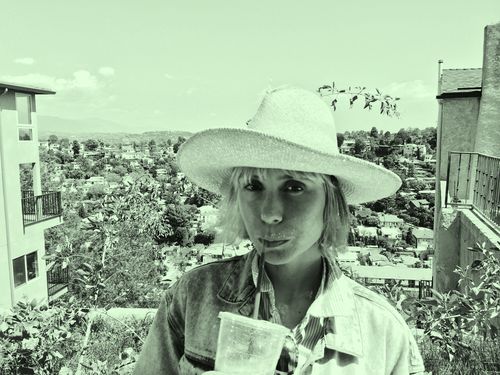
Hometown: Cambridge, MA
Current city: New York City
Attended an arts high school? The Cambridge School of Weston in MA.
College and degree: Bachelor of Dance Arts with a minor in Art History from University of Michigan. Another degree was hanging out in Detroit biking around and going to shows. (Kraftwerk live changed my world.)
Website: www.LilyBaldwin.com
How you pay the bills: I didn't want to wait tables when I came to the city, so I started teaching fitness and wellness. First I was a gym rat, and then developed private clientele. I co-founded a company with Toni Melaas called Hatch NYC. This teaching still informs my directing — bodies reveal so much. Great character study. It's all about supporting people to do things they didn't think they could do — teaching/dancing/directing. I also make creative commercial content.
All of the dance hats you wear: Dancer, Choreographer, Writer, Director, Editor, Producer. Ah!
————————————————————
Describe your dance life ….
The first five years after college:
Pounding NYC pavement. Saying yes to everything. Fancy fun free. Disgruntled. Mediocre shows and work. Brooklyn rooftops. Formative times that shaped my work ethic and built a diverse creative crew I still collaborate with today. And then 2001 happened.
Ten years after college:
Collaborations with my established friends. We all put in our time uptown and downtown. Everyone kept up the rigor. Metropolitan Opera. Doug Varone. Netta Yerushalmy. Joanna Kotze. Faye Driscoll. David Neumann. Noemie LaFrance. Trisha Brown. Then my world cracked open when I performed with David Byrne on his “Everything That Happens Will Happen Today” world tour. Afterwards I couldn’t go back to life as I knew it.
Music plays a main character.
Now:
Film and all things filmic. Telling stories in unexpected ways. Using bodies to say what words can't. Making people feel comfortable in ambiguity. Visceral Cinema that WAKES PEOPLE UP: Seducing people and then corrupting them. Wondering if I can put the electric energy of a live performance into a film-product-thing that people all around the world can watch whenever they want.
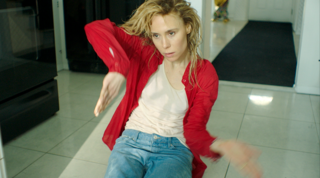
On the set for SWALLOWED
Mentors/someone who believed in you:
My 8th grade math teacher, Lloyd, who didn’t make me feel stupid for not doing things the way you're supposed to. Once I figured out my own circuitous path to making sense of things I felt smart and things got a lot more fun. My acting and directing mentor, Judith Weston. She teaches me how to take authentic risks with real stakes in front of the camera. I’m committed to making film-performance as unselfconscious as possible. June Finch teaches old school idiosyncratic Cunningham technique and reminds me to never stop pointing my feet and circling my head in syncopated rhythms, no matter how many hours I've been sitting in meetings and my body feels like a lump. Mark degli Antoni, my long time collaborator and composer who pushes me to continually mine ideas, and equally understands that nothing is ever done it’s just time to move on. Fritz Smith and Barbara Mahler: Our bony functional anatomy and the tailbone are manifestos of sorts.
Major influences:
Books. All kinds. (Latest faves are Anne Carson, Raymond Carver and Sarah Gerard.) Photographs. (Latest faves are Sally Mann, Philip-Lorca diCorcia and Saul Leiter.) Long walks through neighborhoods all over the world. Subway rides. Murder She Wrote. Filmmakers: Maya Deren, Paul Thomas Anderson, David Lynch, etc.
How did you get into film? Any formal training?
I never went to film school. When I was on tour with David Byrne I began taking snapshots of myself in hotel rooms, and making these raw, stylized documentaries of a place told with dance — or some reincarnation of it. On tour each day/week was a new place and culture. I wanted to capture the essence of a place with my body. I’d watch, then take on the posture of a people — not literally, but in a more intuitive way. I think I have about 9 shorts — raw stop motion experiments, in which I learned the basics of story and studied the rhythms of editing. What story can I tell with 50 still images? And how can the rhythm of movement make a viewer feel? This was the beginning of what I’m calling “visceral cinema." I have worked with composer Mark degli Antoni on all my films. My process involves extensive dialogue between picture, cutting, music and sound. Sonic sculpt narrative in surreptitious and hit-you-over-the-head ways.
I taught myself by making things and making mistakes, and by being surrounded by talented artists. Keeping the stakes high around me. I learned a lot by watching films — studying and writing what I saw and then reading what I wrote I saw. My rigorous approach to my body and dance training undoubtedly gave me the backbone to follow through in uncharted areas where I knew nothing. I'm always setting myself up to do something I've never done. I don't know how I'm going to get to the other side. But then I do. "If you build it they will come." (Thank you Kevin Kostner.)
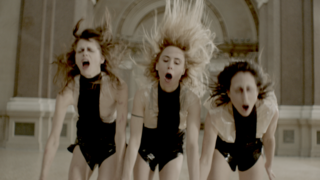
Still from SWALLOWED, with Joanna Kotze, Lily Baldwin, and Netta Yerushalmy
What is on your calendar for 2015?
I am in development for my first feature film, GLASS. It’s based on my experience of being stalked for 5 years and I’ve dug into the criminal case I developed with the NYC SVU to build a fictional film. GLASS is a thriller with stylized dreamscapes that depict peak moments of fear. This elevated genre film speaks to our cultural appetite for fantasism and its consequential blind spots — projection, idealized selves and false intimacy — so enticing, so destructive. I’m also developing two episodic series, and in post production for my short film SWALLOWED, which is part of the upcoming web series COLLECTIVE:UNCONSCIOUS. I am also collaborating with Saschka Unseld on an Oculus Rift film told through dance called THROUGH YOU.
Can you talk a little about the idea of “moving dance into fresh territory?”
I like to tell common stories in unexpected ways. How many stories are there out there? I think they all boil down to a select few — and it’s the nuance of how that makes a story worthwhile.
I use movement and “articulate gesture” to reveal what I call a subterranean truth. Bodies speak what’s between and underneath words. They can bypass alphabets, and communicate universally. This is a thrill and a privilege. I use dreamscapes when the world as we know it is too tentative. That which is feared, fantasized, and felt—but not realized—must be expressed.
How do you find dancers? What do you look for in a dancer?
My dancers are my friends. And they find me.
Someone has to be distinct. It’s a knack really. I have a great community of artists and performers because of all the hats I’ve worn, and I like to draw from them. I like casting people to play versions of themselves.
When working on camera, dancers have to take down “projection." Emotions are so loud in front of the lens. It’s a matter of getting dancers to think their feelings and then translating a real feeling into movement. It’s paramount that emotional intention is clear.
Pretty dance is just too easy. There has to be a reason someone is moving. Dance on camera should be a feeling or choice not spoken but lived through a physical vernacular.
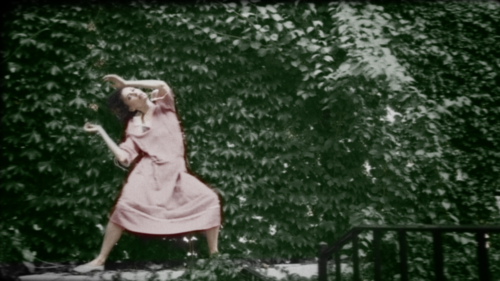
Still from A Juice Box Afternoon
Three pieces of advice for aspiring filmmakers:
Be curious even if something doesn’t make sense. Trust your impulses and work hard at honing them like a sharp knife. When you think you’re done, break what you have, and build something from the pieces.
What equipment do you use for filmmaking – cameras, apps, programs?
I started shooting simple stuff by myself with a friend on my 7D when I was making stop-motion films. But now I work with different DP’s and each project is unique to the circumstances and narrative. I have shot a lot on the RED camera, and most recently have been loving the Alexa. I want to shoot on film next. I have always edited with Final Cut 7, and now I’m learning Premiere. I work with colorists, sound designers and musicians — they all have their own software.
What does a typical week look like for you – in terms of training, creating, studio time, administration?
I'm a mad-hatter. Or perhaps a chameleon. I get to be so many versions of myself, and despite the sometimes craze of disparities, I'm doing exactly what I want. I like being different versions of myself. Everyday is different and I find myself in random situations. I try for at least three dance classes a week and a swim. This past year has been a lot of development — writing and pitching — which is me at my keyboard, rolling around on the floor solving a creative problem while stretching whatnot, and in loads of meetings (lunches/coffees/drinks/office meet and greets/events). Filmmaking has me interfacing with many characters. My years of teaching and dancing in ensemble works have been formative grist: reading and listening to people and their bodies applies to all situations.
Last live performance you saw that really inspired you:
The handball game in the park next to my apartment.
Last dance film you saw that really inspired you:
Harmony Korine’s Julien Donkey Boy. The use of montage, dreamscape and deft editing of hand held footage was so musical.
Wishes for the future:
More of now, with one invisible day added to every week so I can make more.
Final advice to young dancers:
Training your body every day is a noble cause. It doesn't get more human. It's a challenge to keep returning to yourself, your body, the ground and the mirror. There's no escape and no way to lie. You're either on your leg balancing — or you’re not. Not many people can keep this up and this makes you insanely special. Work hard (be kind) and don't expect to know where it will take you.
——————–


 Life as a Modern Dancer
Leave a reply to aioune mbaye Cancel reply