The Virtual Book Club for Arts Administrators – Our First Meeting

Imgres

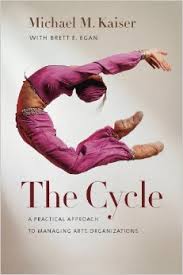
I am thrilled to begin our Virtual Book Club, exploring The Cycle: A Practical Approach to Managing Arts Organizations by Michael M. Kaiser. Some people have officially told me that they are joining in. Anyone is welcome to dive in at any time this month and next!

First of all, I hope that the Book Club has been a simple motivation to get us reading (and reflecting) on our work – whether we run a company, work at a non-profit, run a festival, etc. I am thrilled to have artists working in both theater and dance joining us for the project.

My goal is that everyone who has read the chapters to comment at least three times here. 

1. Let’s begin by positioning ourselves. Who are you? Where do you work? Who have been your major influences as an arts administrator? Do you have any formal training in arts administration? And if you are coming to the discussion new to arts administration – welcome too!

Here I go….

My name is Jill Randall. I have worked in the SF Bay Area for the past 17 years. I became the accidental arts administrator. I have learned by doing, and being around amazing arts leaders (including Sabrina Klein and Wayne Hazzard). My love of information and resources has made me curious….so I am always watching and learning from others in the arts – whether in person or through reading about them. Inspiring work is happening everywhere! While I have lots of formal dance training, all of my administrative skills have been learned over the past 10+ years in the field, doing the work, and working hard. 

2. Next, please write a comment about one or two ideas from the book reading (Intro, Ch 1, Ch 2) that really got you thinking and curious. How did Kaiser’s writing inspire and articulate a concept for you and your organization? What do you want to try out or consider?

Let me begin….looking on pages 9 and 10….I love how Kaiser writes about mission statements. "A mission is a contract between ourselves and our public that defines how we are going to measure success. Our mission answers the question: at the end of the year what must we have accomplished – or be on the road to accomplishing – to be satisfied?" These words inspire me to keep coming back to a mission statement, measuring up and against these words, and to maintain a tie between each action and the mission of the organization. 

3. Third, please comment on something someone else has written on the post today. What questions and connections come to mind? 

—–

Thank you for your patience. You might need to come back to the blog 2-3 times in the next 24 hours to be a part of the discussion as it builds momentum. 

Let’s consider the work of programming and programmatic marketing, as inspired by the first two chapters of The Cycle.

————————

7 responses to “The Virtual Book Club for Arts Administrators – Our First Meeting”

  1. I’m Laura Peters! I’m originally from just north of Boston and went to school 45 minutes south of Boston at Wheaton College where I majored in Dance Studies and Psychology. For the past five years I’ve been living in the Bay Area of California teaching middle school special education, coaching middle school hip hop dance teams, and taking as many types of dance classes as possible. Four years ago, I started a teeny nonprofit summer camp in San Jose called East Side Community Arts, which provides free art programming for youth in East San Jose. My camp has grown in size to over 100 students, but is still a baby in the arts and nonprofit worlds. Next year, I’m heading to grad school to do the Arts in Education Master’s program at the Harvard Graduate School of Education. While I suppose I technically am already an arts administrator, I mostly feel like I learned how to run an arts program by being extra proficient in Google searching, so I’m excited to get some more formal training next year. Hopefully this book club will be a good way to help me remember how to do a bunch of reading and responding… I’m out of practice!
    I really appreciated the message in Chapter 1 about making sure to continue to create daring programming, even when they feel like they have a system or structure “down.” This message resonated with arts organizations I’ve been a part of in the past, as well as how I’m feeling about my own program right now. Kaiser writes, “Sadly, rather than celebrate that ‘something unique,’ too many organizations today have grown complacent with ‘what works’ or ‘what works over there’; they simply program last year’s recipe year after year. This programmatic inertia fails to recognize that ‘something unique’ is what likely attracted its most loyal board members, audiences, and donors to being with” (pg 6).
    It has been exciting to attend Bay Area performances and art shows, particularly by small performing groups and lesser-known artists, who continuously strive to create transformative work. Coming from Boston, I was definitely used to the “slot method” of filling the “Christmas slot” and the “Comedy slot” each year at the major performance venues. It is inspiring to see organizations capture larger and larger “families” of supporters due to this willingness to take risks in their programming.
    Jill, I agree with your thoughts on the mission statements. Kaiser pointed out that while many organizations have painstakingly crafted concise mission statements, there is often disagreement within the organization about how that mission statement actually comes to life. In my teaching organization, we once crafted both vision and mission statements, which was particularly helpful in understanding what the ultimate goal was, as well as how we each planned to attain that goal. This year, as my teachers were planning their curriculum for the summer, each was asked what they personally felt they brought to the mission of our organization, as well as how their class/lessons would live out our mission statement. This has so far proven to be a really powerful exercise, as I am seeing more alignment with our goals within each classroom than I have in previous years.

    Like

  2. Hello! I’m Tanya Chianese, and my current arts administration work consists of running and directing all aspects of my dance company, ka·nei·see | collective. I am from Los Angeles, graduated college at the University of Oklahoma with degrees in Dance and Art History, and then relocated to the San Francisco Bay a few years later. I learned everything I know from the one year I worked fresh out of undergrad as an administrator for a regional ballet company. Due to extenuating circumstances I took on a lot more responsibilities than was probably appropriate, such as planning our multi-million dollar annual budget for the Board’s review, selling Nutcracker tickets on the phone for 8 hours, or applying to grants WAY over my head. I am so incredibly thankful for that experience.
    Quite frankly everything I have read in Kaiser’s book has inspired me and made me feel empowered in my decisions as an arts administrator. I appreciate how clear and to the point he is.
    In the Introduction, WHY ARTS ORGANIZATIONS FAIL is extremely helpful. Each reason makes logical sense, but it is so valuable having it spelled out in front of us.
    In Chapter 2, Programmatic Marketing, again, I mostly appreciate having my gut feelings or administrative thoughts written out as law. Since I did not study arts administration in school, my instincts are all based on experience, and sometimes the fear that those were not normal situations takes control. It’s SO INCREDIBLY RELIEVING to have guidelines written down clearly by someone who is in the top of this field.
    I agree with Jill and Laura about Kaiser’s comments on mission statements. While we all know that is what a mission statement is, sometimes it is hard to remember that it is the goal and everything must relate back to it, and if it doesn’t, something is wrong. It has made me reevaluate, as well as confirm, some of my recent planning and actions.
    Also, the comment about daring programming is encouraging. Personally, the more I dig into the logical, administrative side of art making the less daring I become in my creative process, and it’s a constant struggle to switch the brain from cautious planner to audacious creator.

    Like

  3. Thanks Tanya and Laura for joining into the conversation! Today I am thinking about something on page 10 – “innovativeness.” I know that sometimes the word “innovation” is overused, especially here in the Bay Area. But, reading this section did inspire me to think about the word innovation and to consider it within some self-reflection.
    In your dance/theater company, dance center, festival, etc. – what is innovative? This could be artistic content, use of technology, marketing efforts, dialogues, etc.

    Like

  4. Today I am thinking about something from the book on page 22 about “dreaming.” As administrators, it is so easy to fall into just working on the details.
    I want to propose that we set aside some time just to dream big, wonder, and wander. This could be a solo endeavor – or with employees or board members. This could be a 2 hour session over lunch or a glass of wine. Or pencil it into our calendars for 1 hour a month to sit somewhere and write – in a journal or on big chart paper.
    I know that when I allow myself this time – it brings me back to the original purpose and passion of my work.

    Like

  5. Hey Everyone, I’m Liz Lisle. Since 2001 I’ve worked with the Shotgun Players, a small professional theater company based in Berkeley, CA. I’m the Managing Director here, so I think all day every day about administration and operations – how to stay inspired and keep current with the ongoing national conversation on arts management, specifically in the performing arts.
    We joke around the office about the Shotgun Players PHD program – we have several long-term (10+ years) staff members who run this place without any sort of official degree. Much of my knowledge comes from growing Shotgun from a very small and scrappy company to the vital force that it now occupies in the local community. Being along for the ride is an honor and a daily challenge – kind of like riding a really cool bike up a very beautiful hill. It hurts so good! Before Shotgun I worked around town at several other small arts non-profits, and before the job ramped up to occupy all of my brain-space I also ran a small publishing house Watchword Press and served as Associate Artistic Director for the amazing experimental SF ensemble Mugwumpin.
    I have to say I was surprised by the way this book took off, right from the get-go. I’m doing a lot of head nodding and whispering “that’s so right” under my breath while reading.
    One thing I am especially interested in is this idea of cultural density (page 8-9.) A question I’d love to pose to the group is – How culturally competitive do you feel your area is? How does the Bay Area compare to other locales? Programmatic ambition is so closely tied to the people who are seeing the work and loving it, and the larger community of interest feels, to me, like a very important part of any successful work.
    Looking back at the other posts here, I think it’s interesting that we’re all thinking about the balance between the business, aspect of this work, and the creative art. It can be a challenge to bring risk and surprise into arts management, but I really think the underlying message so far from Kaiser is that as artists we are uniquely equipped to think expansively, to think creatively, to solve these logistical administrative concerns in unexpected and beautiful ways. This book reads to me like a very creative manual. The message is that the art not only happens onstage, or in the gallery, it happens in the office. And when we employ this art to management strategies, it is immediately noticeable on the outside as something stronger, something unique and worth following.

    Like

  6. What a nice observation Liz, in your last paragraph: “It can be a challenge to bring risk and surprise into arts management, but I really think the underlying message so far from Kaiser is that as artists we are uniquely equipped to think expansively, to think creatively, to solve these logistical administrative concerns in unexpected and beautiful ways. This book reads to me like a very creative manual. The message is that the art not only happens onstage, or in the gallery, it happens in the office. And when we employ this art to management strategies, it is immediately noticeable on the outside as something stronger, something unique and worth following.” Thank you for making that mental switch for me!
    Concerning Jill’s comment about dreaming, I also find that the best way to return to my goals and desires, and it was extremely reassuring for Kaiser to make that a point. I like the idea of scheduling “dreaming” time as a part of the necessary planning practice.

    Like

  7. I totally agree. Some of the most important goals that we have set for Shotgun happened far away from any meeting room, when a couple of us finally had the brain space to really think big, and the latitude to articulate the wild idea that would eventually come to steer the future.

    Like

Leave a reply to Jill Randall Cancel reply

About Me

I’m Jill, the creator and editor for this site. I am passionate about sharing artists’ journeys and offerings resources and inspiration for the field.