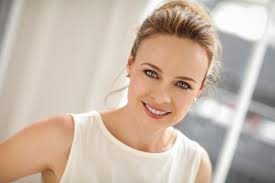
Hometown: Berkeley, CA
Current city: Brooklyn, NY
Age: 44
College and degree: BFA in Dance, SUNY Purchase
Graduate school and degree: MFA from Hollins/ADF at age 37
Websites: tamistronach.com and papercanoecompany.com
How you pay the bills: Teaching…I am now transitioning to adding performing for family audiences as a source of revenue, and public speaking.
All of the dance hats you wear: Artistic Director, Choreographer, Producer, Professor, Yoga Instructor, Dancer, Actor, Singer, CEO Paper Canoe Theater Co., Puppeteer, Teaching Artist
Non-dance work you have done in the past: In the past I was a florist and an aerobics instructor.
——————
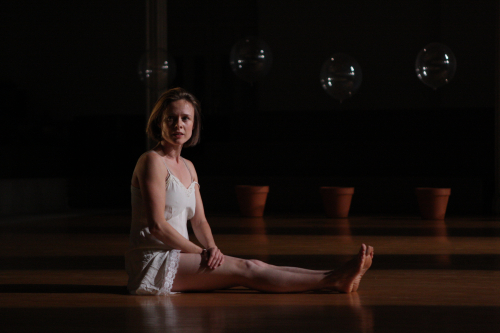
Describe your dance life in your…..
20s: My first year in the city was insane — I started my day working from 6:30AM -11AM at a gym stretching people after their workouts and then worked in the evenings from 6-9PM at a pharmacy selling soaps in addition to teaching the NYC Ballet Workout several times a week at NY Sports Club. In the middle of the day and all weekend I made art dancing with Neta Pulvermacher’s company and creating my own dance works. By the next year I had created a healthy personal training business along with the ballet classes, so things improved. But I wasn’t happy unless I was doing three shows simultaneously. It was crazy — I had no time to eat and would have lunch and dinner on the train between jobs.
30s: After 7 years of working with Neta, I left her company to focus more intently on my own choreography and also to work with some new artists. I joined a physical theater troupe called The Flying Machine where I was exposed to clown and mime techniques and also danced with friends like Monica Bill Barnes and Kate Weare, who are incidentally both from the Bay Area too. In my 30s my own choreography became my central focus, and I started to cultivate a signature style blending all of my influences and interests together into a language that falls somewhere between dance and theater. I also started eating dinners at home — on a table — a big upgrade in my quality of life.
40s: At the end of my 30s I enrolled in grad school because I was interested in teaching at a university level. I was offered a full-time tenure track position at Marymount Manhattan College before I graduated. I then had several very packed years teaching full-time and being a new mom at age 38. Teaching was very stimulating and rewarding, but after 5 years working in a full-time capacity, I stepped away from the full-time position in favor of being an adjunct, because I still have a lot of art making left in me. So I recently co-founded a new interdisciplinary company with my husband called Paper Canoe Company to create high quality family programming. Having a daughter has deeply influenced what I want to spend my time doing and what I want to be making. Paper Canoe shows have been wonderful to work on because my husband and I can play together in the studio trying our hand at new things like puppetry and singing and outrageous accents. Our daughter is really invested in these performances too and even introduces our sock puppet shows. I’m really excited about growing this business over the next decade to build on my work combining arts and education. I’m still of course making dance theater works for adult audiences with my dance company, Tami Stronach Dance.
Major influences:
Pina Bausch, Charlie Chaplin, Susan Marshall and all the artists I worked with over the years.
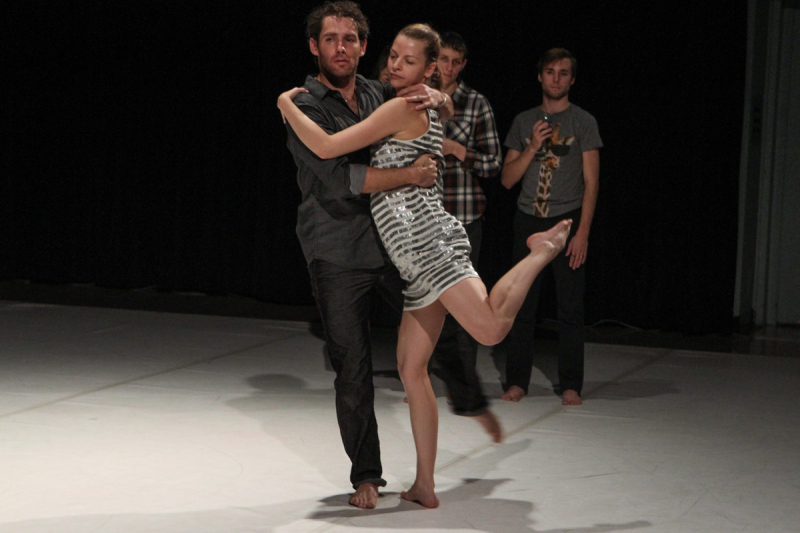
Tami Stronach Dance in Around the Bend © Julie Lemberger
What is on your calendar for the rest of 2016?
I have a commission from the Czech Center coming up. I’ll be in residence the month of September working on a program called Prague NY Effects that pairs an American artist with a Czech artist. For this project I am being paired with Czech composer Tomas Dvorak, who creates interactive performances. We will give several performances in late September in NYC at the Czech Center as well as teach a workshop before heading to Prague at the end of September to perform there. I’m also planning to share a concert with an Israeli choreographer Rachel Erdos next year. We met at Susan Marshal’s SUMAC choreography workshop last summer and have been scheming to share an evening together ever since. We will each show a ½ hour duet in NYC and also in Israel, as well as do some teaching at universities in both countries. The Israeli Consulate has generously offered to support this initiative after seeing my last show, Around The Bend, at the 92nd Street Y. We are working on organizing the dates and venues. I’ll also be remounting a Paper Canoe Company show in the spring called A Socks Fables –a sock puppet show based on Aesop’s Fables that has been a blast to perform for 3-6 year olds as well as releasing an album — a kindie rock opera that tells the story of Jack and the Beanstalk with a twist. It has been so fun to start performing this music, and I’m so grateful for the amazing musicians we are working with. I’ll also be teaching two composition classes at MMC each semester.
Current training practices:
I really believe in seeing shows and analyzing them as a group. There is something so useful about taking the time to really notice all the details of a work of art, to generate questions about it, to investigate those questions and to hear the different interpretations that emerge from seeing a work of art for different people in class. There is a depth to the experience that this kind of engagement provides. It also starts to get young choreographers to think about how something might be read by audiences with different cultural influences and perspectives then their own. It easy to burrow into a very specific aesthetic bubble, and I feel my job as a composition teacher is to keep expanding the frame for young people…to show them there is a frame…and maybe what is outside of it. Once they feel more comfortable analyzing a work of art (through gathering and comparing observations, insights and questions) created by an accomplished choreographer, the same in-depth considerations start to infiltrate the feedback they give one another for class assignments.
What is the role of teaching within your dance life? What do you love about teaching? What does the phrase “teaching artist” mean to you?
I have been a teacher for 20 years. I love teaching because it forces me to keep asking myself questions about why art matters to me and to others — to keep refining the values of my artistic practice.
Teaching composition for me is about creating the space for others to find their choreographic voice — it is so moving to see young people dare to expose themselves through this beautiful medium and start to flex their own artistic muscle. Teaching composition and improvisation allows you to know people in a different way. I enjoy facilitating an experience where we can gain access to these rich aspects of one another that lie beyond small talk, and the daily grind. There is something profound about knowing someone through how they move and how they structure their ideas.
I think being a teaching artist is about making a work of art relevant to all students, including students who don’t want to be artists. Your role is to find doors for people into a work of art by listening to them, by being curious about their own life experiences and how those experiences impact how they view the material. The process of appreciating a work of art ultimately gives rise to students enjoying their own creativity — to see is a creative act. To witness yourself creating connections, noticing metaphors, combing through details, contextualizing information — all of this builds a lot of confidence that can be applied to any area in life. When the process of seeing is laid bare one can appreciate what an incredibly dynamic thing it is to be an audience member. Teaching artists make students understand that they can alter their experience of a work of art by insisting that they dive into it more fully rather than tune out. This is good advice for life too. So often students tell me that something they initially hated comes to life and becomes fascinating/agitating/exciting through analyses and engagement. That practice of diving into a work of art is so important because it alerts us to the fact that on a much grander scale we have the capacity to generate meaning. Every experience we have becomes an opportunity — we can choose to notice more, to listen more and to dig deeper into the things that we encounter and thereby carve out a more meaningful life.
Role models and inspiration for your teaching practice and pedagogy:
The Lincoln Center Institute gave me my training as a Teaching Artist. The ideas and methods they shared with me form the backbone of my pedagogical approach. The Philosopher in Residence at Lincoln Center when I was there was Maxine Greene, whose ideas on why art is relevant to a democratic society had a profound impact on me. My graduate school program also had a deep impact on me insisting that I re-examine dance history through a political lens, which I had not previously considered.
What are the skills a contemporary dancer needs in 2016?
I think to be a dancer in 2016 you need to commit to sharpening your administrative skills and become interested in the business side of things. Expect to have several jobs. My generation all went to art school dreaming of graduating and getting into a dance company where we would dance 8 hours a day and then go to the hot tub. But that kind of company model was already drying up, and I saw that if I wanted to stay active I would need to generate opportunities for myself. One skill you will really need is networking. Pay more attention to that than you think you should…reprogram your brain to see administrative work as creative work. Trust your taste. It’s ok to like what you like even if its not popular…things go in and out of fashion. What you are passionate about will cycle around — keep refining your voice so when the microphone comes, you are actually ready to make some noise.
Non-dance interests, specialties, service work, or hobbies important to you:
Women’s rights, minority rights, animal rights. I dream of retiring and volunteering at an elephant sanctuary.
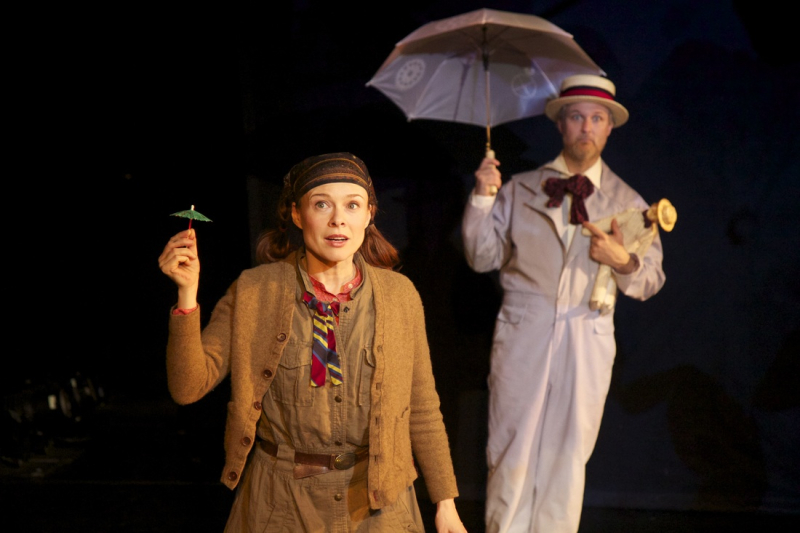 Paper Canoe Theater Company
On balancing parenthood and artmaking:
It is hard enough to eek out a living as an artist without a child. With kids you are definitely rolling a ball uphill. For me, creating family programming in addition to my previous work with my dance company was a creative way to address this. It utilizes my skills and interests but they are re-contextualized and there is a broader market there. Also this allows my daughter to connect easily to what we do. I'd hate for her to dislike art because it’s the very thing that keeps me away from her. I made a really conscious decision about finding a way to have the practice of making art bring us together as family.
Recent performances you experienced that really inspired you:
-Soho Rep’s An Octaroon by Branden Jacobs-Jenkins and directed by Sarah Benson
-Chekhov at Lake Lucille, The Sea Gull directed by Brian Mertes
-Okwui Okpokwasili, "Bronx Gothic"
-I can't wait to see Anne Teresa De Keersmaeker at BAM in October!
Advice to dancers wanting to move to NYC:
If you are set on the big apple, give yourself two years to get situated — it really takes a little longer there. See everything at BAM. Take the workshops from the people you want to work with in addition to auditioning — but if you haven’t been “picked” yet get in the studio and make stuff or dance for a budding choreographer, as that’s the easiest way to meet people. Know that being easy to work with — being mature, responsible and reasonable — is very, very valuable and as important as talent/training. The current system is hard on women who have to compete against much larger numbers for fewer positions. Know that; be tough. Let it motivate you to work harder, and keep fighting for more support for female choreographers in the field.
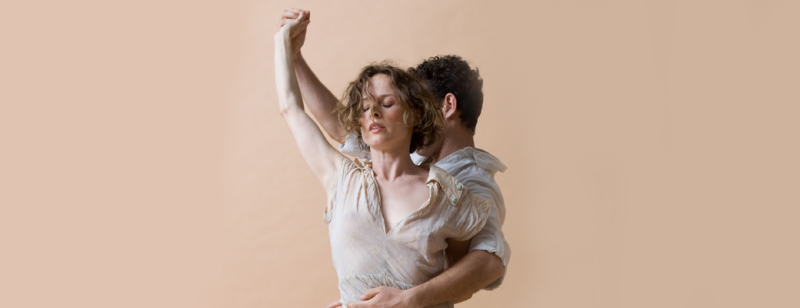
Final thoughts: Hope/belief/love of the profession:
I believe that a life spent embracing the body, a life spent moving, of tuning into our instincts and senses, is the richest form of being alive. While dancing, we can practice staying open, responsive and flexible — physical qualities that become a guide for our emotional life…how we hope to act in our relationships and approach our work.
Our world often devalues the physical. It asks us to disassociate from our body, or it over-sexualizes the body, or under-sexualizes it, or it only wants to allow young bodies to be seen. Dance can offer something wonderful — a path to a clearing. In an embodied state we can experience our bodies as intelligent, sensual, powerful, vulnerable, aging and growing all at the same time. This offers a kind of grounding one can drop into at anytime. For me dance has been a teacher in learning to embrace contradictions — to see contradiction itself as beautiful in so much as it affords me a better angle on truth. Useful contradiction can be found everywhere — when executing a dance movement, such as a relevé, where you focus on going down to go up. In an improvisation class it becomes more philosophical as you must become both a leader and a follower simultaneously. In modern dance I love to see how abstraction and pedestrian readable gestures collide and vibrate against each other.
When I dance, my body and my mind are experienced as two sides of the same coin…they are not the same thing and yet they are….the coin has to be in motion for me to see the whole picture — the coin must keep spinning in my mind…..dancing.
————
Related posts:
————————-


 Life as a Modern Dancer
Leave a reply to linda laflamme neska Cancel reply