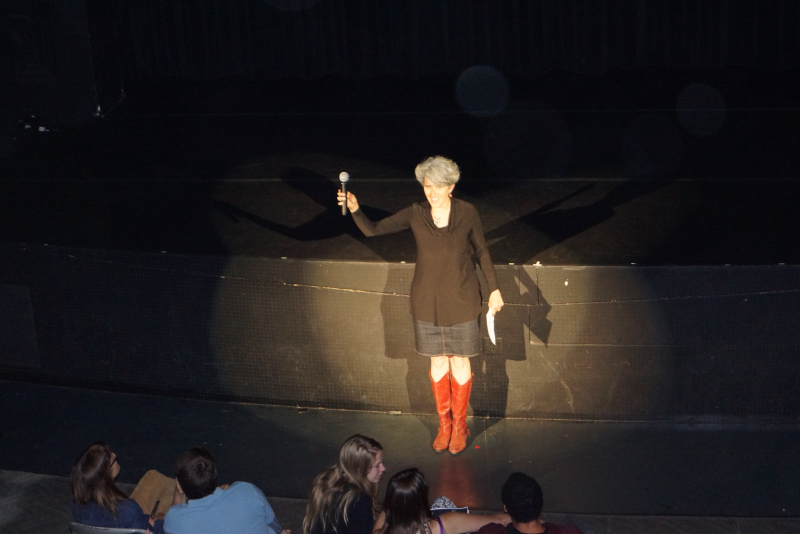
 Hometown: Belvedere, California
Current city: Berkeley, California
Age: 49
College and degree: UC Davis, BA in Studio Art
Credential: San Francisco State University, High School Teaching Credential (My credential is in Visual Art, with a supplementary credential in dance, since there was no dance credential at the time)
Website: http://berkeleyschools.net/berkeleyhighdanceanddrama/
How you pay the bills: Full-time Modern Dance Teacher at Berkeley High School
All of the dance hats you wear: Currently I am a dance teacher, but over the years I’ve been a dancer, choreographer, teacher, arts-advocate, festival organizer, curriculum designer
Non-dance work you do or have done in the past: Outdoor education, office work
———————–
Please describe your….
20s – The week I graduated from UC Davis, I was walking down the street, and thinking: “ SO: college is over. Now what?” I had a really great Modern Dance teacher (Bobbie Boatman), and I remember thinking, “I want a job like hers.” “Don’t do it!!!,” she said to me. “There are no jobs. It’s really hard. I’m really lucky to have this job, but there aren’t many of them.” Well, I remember thinking, I’m going to be lucky too.
I moved to San Francisco, saw and performed in as many shows as possible, and became part of a vibrant, exploratory, avant-garde dance/theater world in SF at that time. This was a fun and fertile time: It was my introduction to improvisation – both Contact Improv and Action Theater – and I was hooked. I found the moment-to-moment exploration of movement/feeling/performance to be super-compelling, and a welcome relief from learning steps and having to conform to a set ideal. I loved the invitation to bring imagination, humor and physicality into performance. In my late 20s, I created ETIQUETTE Physical Theater along with Marielle Hare and Cassie Terman Tunick, staging entirely improvised, fully produced shows that were so tightly knit, audiences often didn’t realize they were witnessing the shows being built on the spot.
In my twenties, I also began developing my teaching craft. Gloria Unti hired me at the Performing Arts Workshop, and for four years, I taught all ages in the San Francisco Public Schools, from pre-K through High School, specializing in new immigrant, special education and deaf classrooms. It was exciting to see how dance could be such a powerful tool for teaching language, physical awareness, and communication.
At 27, I took a job teaching dance at a new magnet arts middle school in San Mateo, and simultaneously attended night school at San Francisco State University to receive a teaching credential. I learned a lot about teaching with my mandatory, 6th grade dance/PE class, but mostly I learned that I didn’t want to teach middle school.
30s – In my early thirties, I did get lucky, and was offered a teaching position at Berkeley High School, where I’ve been teaching now for seventeen years. In my years there I have worked to make welcome a more diverse student body in the modern dance classes, and to equally value a variety of dance styles in our student-choreographed shows. In 2004, along with a few other teachers at the school, I helped found the Arts & Humanities Academy – a small school within Berkeley High dedicated to integrating the arts into the academic environment and to creating more opportunities for students to apply their success in the arts to their academic pursuits.
At 36, I directed and produced my first full-scale production, 28 very short scenes about love. It was very satisfying artistically, but after the three-year process, with various stages of production, I had to admit to myself that I wanted to get out of the studio and focus my energy on other aspects of life.
40s – My daughter was born 4 months before my 40th birthday, and my son was born two years later, which changed my relationship to my teaching and to my dancing. As a teacher, I’ve learned to become more efficient and more focused. I have to make the most of the time I am at school, because I can’t spend hours afterwards thinking and preparing. I’m also more creative in my choreography at school now, since I’m no longer getting that creative energy out with a performance company of my own.
In my forties, I’ve returned to technique class. After a neck injury some years back, I took a break from Contact Improvisation and looked for other dance forms to get my fix. I find that my older body is happy revisiting the structure of good old modern dance classes. It’s helpful to me as a teacher, of course, to see how others orchestrate their classes, but also it’s just so much more fun to be in class now. I get the same kind of joy out of class now that I did as a child – before I wanted anything from dance, as a career. Now, again, I find that I can just enjoy the challenge and the beauty and the pleasure of dancing, without the painful internal monologue of my earlier years – when I was in a constant state of comparison, frustration, etc. Now, again, it’s dance for dance, and I love it. I’m so grateful for that.
In recent years, I’ve begun taking Cuban Salsa classes, which are incredibly humbling, and I’ve returned to a girl group I dabbled with years ago, doing body rhythm with Evie Ladin’s MoToR. I was on stage with that group last fall (for the first time in a decade) and had a blast. As my body and interests change, the style of dance and performance I’m attracted to shifts, too, but overall, dance has been a constant in my life. It’s where I go to feel myself and to feel inspired.
Major influences:
Ruth Zaporah has been a huge influence on me – I love the exercises she created in teaching Action Theater, and I learned so much as a teacher from the way she structured her lessons.
Gloria Unti provided an image for me of how to continue teaching dance for a lifetime.
Joe Goode was the first choreographer I saw who used personal narrative and HUMOR in dance/theater — loved that & loved his technique classes in the ‘90s in SF.
Sara Shelton Mann and Contraband created the most energetically compelling dance/theater pieces in SF in the 90s.
Pina Bausch and Ohad Naharin have always been idols, for the stunning beauty and humor in their work.
And my fellow dancers/performers in SF – Sten Rudstrom, Cassie Terman Tunick, Marielle Hare, Joanne Nerenberg —all friends and influences.
Current training practices:
Now I try to take dance class at least once a week — either Release Technique or Cuban Salsa — and often go for a big walk or a swim once a week as well.
On the topic of caring for a teacher’s body:
Ayyy! I’m still trying to figure this out. There’s a LOT of repetition inherent to teaching, and sometimes that’s really stressful on my body. I get acupuncture regularly. I try to attend to injuries. Sometimes it’s hard. I find, more than anything, that it’s important to KEEP MOVING. Stay strong. Stay mobile.
I also structure my teaching year so that I am not teaching five technique classes each day: I bring in guest artists; students work on choreography assignments; they learn routines they can run on their own. All of that helps moderate my own physical output.
Advice to dancers wanting to get into teaching in a K-12 public school:
Go for it! There is work, despite what my mentor Bobbie Boatman said to me. I’m actually surprised by how many dance teaching jobs there are in the Bay Area public and private schools – many more than I ever imagined when I was growing up.
I love teaching in an institution, because I don’t have to hustle for my students. They are right there. I have ultimate respect for teaching artists who travel the globe giving workshops, but I always knew that I did not have the stamina or ego for that kind of personal promotion. Also, I like being a part of a community. In some ways, schools are at the center of community life, and I enjoy the influence that that brings. The artistry we present on our stage impacts not just the dancers themselves, but the audience of friends, parents, grandparents, etc. And the more invested I become in this community, as a resident and parent myself, the more I appreciate the influence that teachers have on the spirit of the community as a whole.
How is teaching an act of social change?
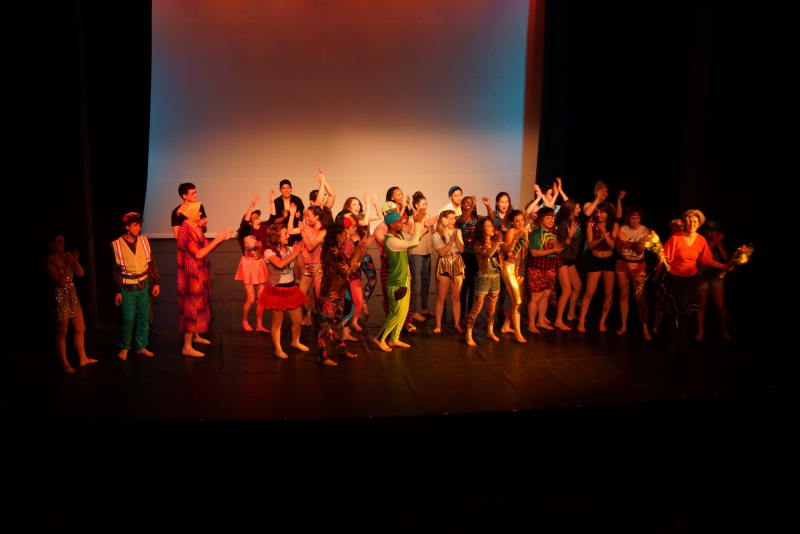
The public schools are our one shot at leveling out the playing field in this country. It’s where we say: education is yours! It’s free, it’s here, it’s for you. This does not always mean there is an equitable outcome, but I do think it’s an honorable attempt that we, as educators, are trying to make. I want the arts to be at the center of public education in the United States. I want students to feel that their creativity is a valuable part of their personhood, and that the force of their imagination can become the rudder for their lives. I believe that giving students the ability to invent artistically — to envision, choreograph and stage their own dance, for example — is an extremely powerful experience. It can change the way they think about themselves and the world around them.
I love teaching in an urban, multi-cultural setting because, artistically, everyone brings something to the table. Whether you’ve been dancing on the street, in your living room, or in a ballet studio all your life, if you’re a great dancer, you’re a great dancer. I purposefully create a loving, non-competitive environment in the dance studio, so that young dancers can learn to truly appreciate ALL kinds of dance, and value all dance forms equally. Dance can build a bridge across a lot of cultural difference.
Current inspiration, questions, and curiosities around dance:
I wonder how to create more of a ripple in the world of arts education. I would love to see dance become an integral part of public school education, in the same way visual art and music often are. It’s happening in certain pockets of our country. I’d like to help bring that about more fully in the Bay Area.
Can you talk about the upcoming school year? What will you be teaching? What non-dance classes, committees, advising, etc. do you work on at Berkeley High? What is new or evolving? What are you really excited about?
I teach a full load of Modern Dance classes at Berkeley High, about 185 students total: 3 beginning classes, one intermediate and one advanced (Dance Production) class. All of them are performance and choreography oriented. I teach technique in the Beginning and Intermediate classes. I weave Contact Improvisation, Action Theater and Choreography/Composition throughout. I bring in a lot of guest artists to present a range of other dance styles: Salsa, Hip Hop, Body Percussion, Indian Kathak, etc.
As always, what excites me most is the students. I love them. And I appreciate the opportunity to exert influence at this very formative time in their lives. High school kids have a lot to say: they’re thinking, they’re feeling, they’re enraged by the world around them. They are practical people who want to know what we’re doing today and why. I love all of that. And I enjoy facilitating their creative process and pushing them to go for it, in the boldest, bravest, most fulfilled possible way.
I’m not on any school committees right now at the High School, but I am the head of the Arts Advocacy Committee and the Shared Governance Council at my children’s elementary school, where I am constantly looking for ways to bring more arts into the school. I also serve on a district-wide Arts Committee.
Last performance you saw that really inspired you:
Seeing the film Mr. Gaga about Ohad Naharin, choreographer of Israel’s Batsheva Dance Company, was inspiring — a beautiful portrait of his rehearsal process. He makes the work I love most in the world right now.
Final thoughts: Hope/belief/love of the profession:
You know Woody Allen’s line in Annie Hall about “Those who can, do; those who can’t, teach; and those who can’t teach, teach gym?" It took me a really long time to get over that line. Don’t waste your time.
Now, after more than twenty years as a dance educator in the public schools (where my classes count as PE credit!), I would replace that line with: Teaching is a remarkably challenging and fulfilling profession. There is constant, relentless room for improvement, and an invitation, always, to better the world you live in. Teaching is an art unto itself – not just an artist’s “day job."
There are many, many ways to construct a life with dance at the center. Performing with a modern dance company is one possibility, but there are many more: teaching, running festivals, production work, dance as therapy/healing art, directing community center programs, arts administration, etc.
Don’t worry. Follow your path. Be mindful of money. Respect your decisions.
——
Related posts and websites:
Website: Bay Area High School Dance
Artist Profile: Wendy Jones of Lowell High School (San Francisco, CA)
Artist Profile: Valerie Gutwirth of John Muir Elementary School (Oakland, CA)
My Dance Week: Teaching Full-Time in a High School (Kristin Blatzheim)
My Dance Week: Teaching Full-Time in a High School (Monifa Kincaid)
——————————


 Life as a Modern Dancer
Leave a reply to Jordan Winer Cancel reply