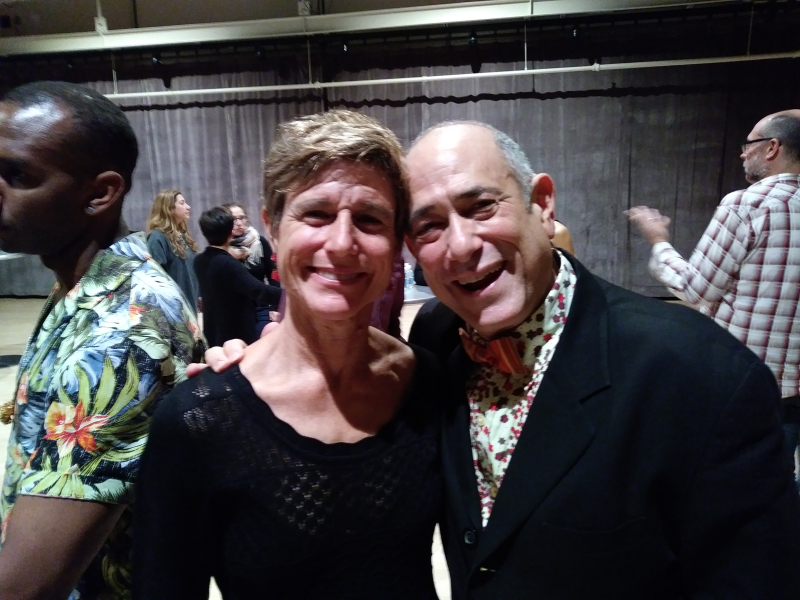
 Carol Kueffer and David Dorfman at the 2017 celebration at BAM
Can you share about your years working in the company?
I danced with David Dorfman from 1985-1996. David saw me dance in the senior final performance at NYU. I then auditioned as a dancer for The Yard, a dance colony on Martha’s Vineyard, MA, where David was one of the choreographers. Following The Yard he asked me to continue dancing with him as he formed David Dorfman Dance. We rehearsed primarily at 890 Broadway where the Broadway dancers also auditioned and rehearsed. It was not uncommon in this building to be in an elevator with Gregory Hines or walk down a hallway packed with Annie look alikes. Bill T. Jones also rehearsed here, and David and Bill seemed to be the only modern dance companies in the building.
We rehearsed four hours, five days a week, and toured extensively throughout the United States and Europe. I took classes regularly at the Cunningham Studio on Bethune Street and ballet with either Cindy Green, Jocelyn Lorenz or Ernie Pagano. Occasionally I took Jazz with Lynn Simonson and West African dance at Dance Space on Broadway.
David’s work was release based and athletic. The dance vocabulary was primarily lifting, rolling, running, tackling, flying and falling. Years later the work included leg extensions and took on a wider range of movement styles. The company was like a family. I loved dancing, rehearsing, and performing with everyone. David established an environment of mutual respect and love. The dancers had a strong voice in the work. This came through in the reunion concert as well, where diversity and individuality were embraced and celebrated.
My first trip abroad with the company to Scotland was one of my favorite tours. We were young, excited and enthusiastic to be performing and traveling abroad together. In a tour that occurred shortly after the Berlin Wall came down, we performed in Hamburg, Germany and then traveled to Rugen, an isolated island in North Eastern Germany. Still closed off to western tourists, the influence of Stalin was a dramatic contrast to West Germany.
The projects that were the most meaningful to me were probably the "Athletes Projects,” which were performed over thirty times, in eighteen states and in two other countries. The performance in Helena, Montana was for me a life changing three weeks. For the first two weeks I was alone with David rehearsing with athletes in the community. The third week the rest of the company joined us. This was in the middle of winter, seven degrees below zero, and athletes came together to share their personal stories of intimacy, identity and dreams, and for most, this was their first experience dancing and performing. I was deeply moved by the courage and vulnerability of these athletes and grateful to be able to work with them in this setting.
Seeing the company last week at BAM…..what did you enjoy and appreciate as an audience member? What did you see – that you had a physical memory/sensation of as well?
As an audience member, I enjoyed being surrounded by the original company members — Peggy, Curt, Ginger and Tom, and the many supporters and friends. Much of the movement was developed by the five of us and Lisa Race (who is now David’s wife and performing as a guest with the company). It was fascinating to see how the movement had evolved after all these years. I found myself thinking, "Ah, that’s Ginger’s move, and there’s Lisa’s influence." The highlight of the show was Lisa and David’s duet. At this point in the evening I lost it and was overwhelmed with emotion. The duet encapsulated what I love most about David’s work; humanity with all its clumsiness, love, strength and beauty expressed in movement. The technique is all there but so much more.
What has David’s influence been on your life?
My formative years of dancing were with the company, so the dancing and thinking about dance are major influences. Respect and giving authority to his dancers were driving forces in David’s creative process, and I believe these are attributes I bring to my teaching and collaborations. Trusting myself and others comes from David’s confidence in allowing the creative process to be at times messy, fun and always fluid. During my years with the company work, family and art were interconnected and valued by David and the company members. I am grateful for this more than anything else because of the way that it has had an impact on how I live my life.
Can you share a little about your dance life now as a teaching artist and choreographer? Also, current movement practices and training important to you?
I taught college students for many years and now teach children, which I find to be unpredictable, full of surprises, and very rewarding. I take from several modern technique teachers at Shawl-Anderson Dance Center in Berkeley, CA. Currently, I enjoy Rogelio Lopez’s classes. Ballet is also an occasional part of my practice. Aerobic training: I swim an hour, four to five times a week.
Last question….about joy. How is dance an integral part of your concept of joy?
My mother is responsible for creating an environment where dance was a major part of my childhood. One of the first performances my mother took me to was at the San Francisco Opera House, and I experienced rapture in the sixth row watching Baryshnikov appear to fly on stage. As a young ballerina, I loved to jump, leap and turn and felt freedom and vitality in my body with these movements. I continue to love turning, spinning and moving quickly. Joyful dancing motivates me to engage fully in life.
————-


 Life as a Modern Dancer
Leave a reply to Margaret Albertson Prindle Cancel reply