
Hometown and current city: Salt Lake City
Age: 89
Website: www.ririewoodbury.com
—–
I graduated from the University of Utah. Elizabeth Hayes, who was later my boss and my good friend, pushed at me to audition for the Orchesis club for dance. She really pointed out my career for me. I later attended New York University for my master’s degree in dance. Martha Hill was head of the department, with other teachers who all became the new faculty at Juilliard the next year.
Joan Woodbury and I started our company in 1964. We had another company ten years earlier, so we have worked together for 64 years. It has been a very fruitful and fulfilling journey. We turned the reigns over to Jena Woodbury as CEO and Daniel Charon (from Doug Varone and Dancers) as Artistic Director about 5 years ago, and the company is going strong. One interesting thing we accomplished was to be appointed as the official company to restore Alwin Nikolais works. We were very popular in France with this work, touring for 7 weeks a few years ago, the longest tour of any foreign company. We also feature works from Daniel as well as some restorations of choreography from Joan and me. We hire other choreographers to do new commissions or set former dances on our company.
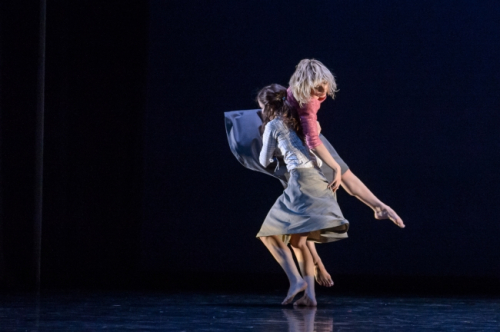
Ririe-Woodbury today. "Storm" by Daniel Charon. Photo by Stuart Ruckman.
When we started touring in the 1950’s, Joan and I paid for all the costumes, travel and such, and then we would be reimbursed as we were paid by sponsors. I remember a few years ago, a former dancer from an early company showed me a letter that said, “Dear Julie, we are happy to give you 100 dollars as payment for the year.” In those early years the dancers rehearsed and toured for free. What really gave us a great jumpstart were the two national programs in dance sponsored by the National Endowment for the Arts. One was “Artists in the Schools” – where the company would visit a site that was paid for by the Endowment. The other was called “Dance Touring Program;” it took us to colleges and community performances. Each state could apply for one visit in the sponsored arts such as dance, music, poetry, etc. The residency in dance was 6 weeks with a “Dance Movement Specialist” visiting for 2 weeks prior to the company's visit, to prepare the site, and two weeks after, to sum up what had happened. Dance was extremely popular. Ririe-Woodbury did particularly well because Joan and I were teachers, and we were able to train our company members to be successful in elementary schools, where the bulk of the residencies were held. We also trained members of the other companies to be able to work in the schools during the one week intensive workshops held during the American Dance Festival each summer. Out of the 100 movement specialists, over half had been trained in Utah. So it turned out that during the 13 years the program existed, Ririe-Woodbury garnered the most bookings. The pay was great, and we had as much work as we could manage. One year we toured 40 weeks. That was way too much, so we learned to pace ourselves.

When I was in my 20’s I did my academic training, had my first baby, started teaching at Brigham Young University and later at the University of Utah, and met Joan.
In my 20’s Joan and I built the dance program in Utah. I took over the job at the U. when Joan went to Germany for a Fulbright study with Mary Wigman. When she returned both she and I each had a child, so we asked to be appointed as half-time teachers, splitting the full-time job that was available. They had never heard of “job sharing” in 1955. But the request was honored, and we embarked on about 10 years of teaching full-time for half-time pay. This dedication was responsible for building the dance program to one of professional merit. Gradually we both were hired full-time and became professors.
So my 30’s were spent developing a strong undergraduate and eventually graduate program at the U. As our dancers became more proficient and skilled as choreographers, we found we were no more needed to choreograph and perform in our concerts, so then as an outlet for us as performers and choreographers we created a touring company. It was called “The Dancers Company."
Our 40’s and part of our 50’s we (now named Ririe-Woodbury Company) toured with the National Artists in the Schools Program and also the Dance Touring Program which created residencies in colleges and communities for adult programming. These touring opportunities really made us as a company.
In our 60’s and 70’s we embarked on international touring. We also were awarded the Nikolais works by Murray Louis, who kept both his own and Nik’s companies going for a while after Nik’s death, but it became too much for him, so we benefited. We toured China several times, France almost every year, Spain, England, Africa and others. This year – in our 80’s – Ririe-Woodbury is invited by the State Department to tour Mongolia and South Korea. So we are still going strong.
Collaboration was the secret to our success. Joan was brilliant on finances; I got us into the teaching of children and also into the National Endowment touring program since I was appointed by the National Dance Association to represent dance when the AIS and DTP were created. I choreographed and performed well into my 50’s. We still retained our University professorships on a part-time basis. Joan would tour in the winter, and I would teach at the U. Then in the fall, I would teach and Joan would tour. This helped us raise our families (my four and Joan’s three children) and keep the University contact. It was a very productive collaboration that we created.

Start small and grow as opportunities come. Hire staff as bookings grow and money comes available.
I always loved Pilobolus and Momix. Joan and I have a long association with Moses Pendelton and Alison Chase. We performed with Momix in improvisations when they came to Salt Lake.
I have always been a teacher. Since the residency programs through the Endowment were based on teaching as well as performing, I have taught all over the world. I am committed to giving children the joy of dance in their lives and have taught in many school situations during our touring. I learn more than the students when I teach. It is very fulling. There is always a curiosity and satisfaction in creating new problem solving strategies with students, and watching them grow in skill and artistry.
I think in examining my own career, that searching out the most challenging and successful teachers as mentors has made my own teaching successful. I was fortunate to study with all of the modern dance greats in the formative years. I did not study with Isadora, but I worked a bit with Ruth St. Denis and Ted Shawn, Martha Graham, Alwin Nikolais and Murray Louis, Charles Weidman, Merce Cunningham, Helen Tamaris, Hanya Holm, Doris Humphrey, and Anna Sokolow. The two teachers who influenced me most were Alwin Nikolais and Anna Halprin. I worked with Halprin for 5 summers outdoors on her gorgeous deck studio. I think performance enhances teaching, and being a teacher enhances personal choreography and performance.
I think seeking out many venues for teaching, as well as studying with the greats as indicated above, will inform your teaching. Working with students of all ages and backgrounds will challenge you to come up with new strategies. I took summer courses for 15 years to juice up my teaching palette. I always came back to the studio refreshed. I was a guest teacher in many instances. I taught children in Puerto Rico several times with no Spanish language ability and in Hong Kong to Chinese speaking students. I taught in Belgium to mostly French speakers, and in all instances was able to use the language of dance to communicate.

"States Rendered" by Doug Varone. Photo by Stuart Ruckman.
I think the biggest change in modern dance is the way people choreograph. Dance is much more abstract and intense. In our day, we did humorous dances that were very popular. I find dancers these days do not understand humor and do not use it. I find this sad. I think we were more accessible to lay audiences. I know Nikolais would always say, “If I can connect with Aunt Minnie in the balcony, then I feel I am a success." His dances, with their very colorful visual displays, always capture me. That is why I am so pleased that we can perform his repertoire. His dances are still captivating, fifty years later. This I call real “art."
Legacy has been a vital part of my dance life. The legacy of Betty Hayes (my principal college teacher, later my boss, and still later a dear friend), whom I helped in her 90’s since she had no relatives, was an important part of my dance life. She saw in me something I was not aware of. Without her encouragement I may never have been in dance. Of course the legacy of Nikolais, his artistic principals have guided me all these years. Anna Halprin instilled in me the skill and love of dance improvisation. Nik added to that and Hayes as well. I have used improvisation as an important performance skill as well as a key to successful choreography.
I love the art of dance. It has been a major part of my life and has served me well. It has opened up the opportunity of meeting and working with fascinating people all over the world. Many students have said, “You changed my life,” and that has happened through their own discoveries that I was fortunate to inspire.


Related posts/artist profiles:
Alumni of the University of Utah
MFA Program Spotlight: University of Utah
———


 Life as a Modern Dancer
Leave a reply to Wendy Thompson Cancel reply