 This Great Wilderness by Jamar Roberts. © Todd Rosenberg Photography
What’s To Come: An Evening Spent at Juilliard’s New Dances
By Phoebe Ballard
Part 1: The Show
This is my favorite environment. The lobby is abuzz with excitement: parents visiting from out of town, friends from neighboring departments, members of the dance community affiliated with academia and beyond. Patrons who simply know ‘Juilliard New Dances’ is synonymous with an-evening-spent-admiring-exceptionally-talented-young-movers. This show, the first New Dances curated by Dance Department director Alicia Graf Mack, features new work by renowned choreographers Amy Hall Garner, Jamar Roberts, Andrea Miller, and Stephen Petronio.
This is my favorite environment because this night is about the undergraduates. The undergraduates who spend their days and evenings in the studio – soaking up everything they can. Tonight (and yesterday, and tomorrow, and Saturday two times, and Sunday) they finally get to share. They get to be relished. They get to be applauded. They get to perform.
I can’t imagine how much excitement vibrates backstage.
 Sight & Sound by Amy Hall Garner. © Todd Rosenberg Photography
Sight & Sound by Amy Hall Garner
The show opened with Sight & Sound, choreographed by Amy Hall Garner and performed by the Class of 2023. A shimmering, bronze, rectangular bar spanned the width of the stage and hovered about twenty feet above the floor. Underneath, as the slow glow of the lights revealed, lay the 24-person ensemble methodically entangled in a rippled patchwork. A centipede made up of bare limbs and black covered torsos. It was a striking image I could not shake for the rest of the work. Everything brought me back to that defiant stillness.
Sight & Sound was pushed forward by rich changes in light, the cyc turning golden or blue or red, propelling the bronze bar to move up or down and instigating a novel physicality in the dancers. Against the stirring sound, the dancers' bodies reverberated and moved in what felt like silence. Perhaps their bodies were quieted by the rich live music of Joel Wenhardt. Their ferocity, however, was not quieted – darting out at me with agile grace. Dancers swept in and out of the space, running, connecting, enveloping themselves in daring feats of movement. Intimate partnering and piercing limbs darting out in all directions. These feats were underscored by small skitters manifesting in the legs and sometimes rippling through the arms. Each time these sparks of movement took place, my mind leaped back to the centipede image from the beginning. Under this ever-shifting bronze horizon, the dancers expanded to become larger than life (without making a sound).
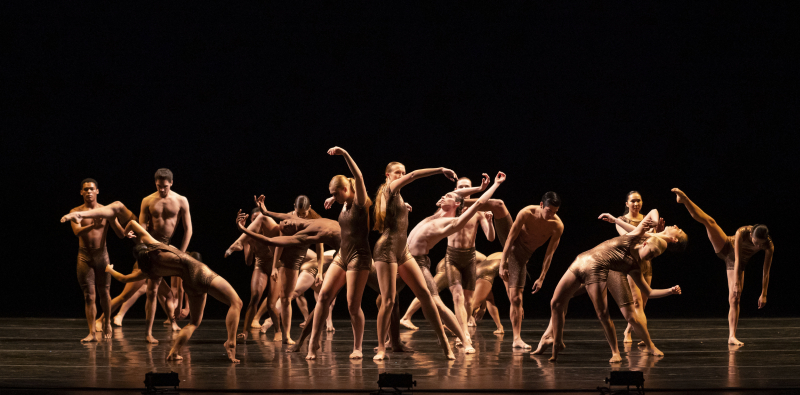 This Great Wilderness by Jamar Roberts. © Todd Rosenberg Photography
This Great Wilderness by Jamar Roberts
Next was This Great Wilderness, choreographed by Jamar Roberts and performed by the Class of 2022. As the curtain rose, the cold lights made the body-filled space feel hollow. Eerie but compelling – twenty-two powerfully bare beings were arranged meticulously to frame the center of the space. The rich rhythm of a live saxophone echoed through their bodies, making it clear there was not a note of music, not a single body part, that was unaccounted for in this choreography.
I found myself searching for narrative, perhaps because of the title, perhaps because of the eerie almost mysterious nature of the staging and the lights. Were they in a forest? A supernatural rendering of A Midsummer Night’s Dream? I was compelled by the choreography – was drawn to the exactitude of it. Each dancer inhabited their dimensionality with piercing precision. There was something important about the center; they kept coming back there. I saw their silhouettes but also saw each rib, saw the capabilities of both. The dancers operated in separate universes, were beautiful but interchangeable. They formed a mass movement choir, people kaleidoscoping in and out of center, growing smokier and smokier until the stage went dark.
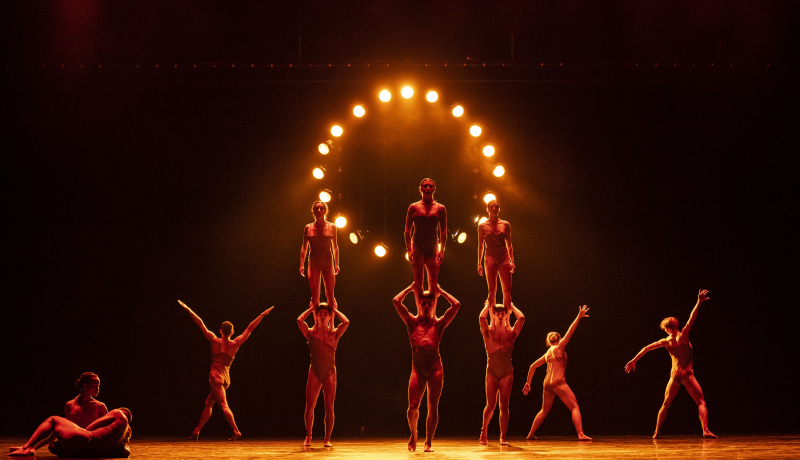 Desde by Andrea Miller. © Todd Rosenberg Photography
Desde by Andrea Miller
Desde, created by Andrea Miller in collaboration with the dancers of the Class of 2021, stole the show. The instant the lights came on, there were gasps from the audience. An LED ring of fire hung in the middle of the stage, swimming in a sea of fog. From this fog emerged dancers flanked in straight lines as they traveled downstage and disappeared, honing the pulsing rhythm of Nicolas Jaar’s music in their grounded bodies. Primal, powerful and rhythmic vestiges of phrase work metamorphosized from line to line. They lived in the bend of their knees, the floor of their pelvis. I could have watched this beginning the whole time.
The piece progressed, and the pulsating rhythm of the music dissipated into a soundscore of shattered glass. These lines evaporated into just two dancers on stage. They remained ephemeral creatures, the same ones who had emerged from the fog. Intimate feats of partnering ensued, tangling the limbs, contorting one body upside down into the empty space of another. They were tethered together, a directness in the extreme capacity in which their bodies performed. The Gaga-like movement vocabulary left me leaning forward the entire piece. The movement was so powerful, so researched, I was not searching for anything else. I just wanted to keep living in the warm suppleness and agility of the dancers’ bodies.
It ended the way it began, but instead of moving away from the ring of fire, they moved towards it, this time submerged in fog. Headed back to wherever they came from.
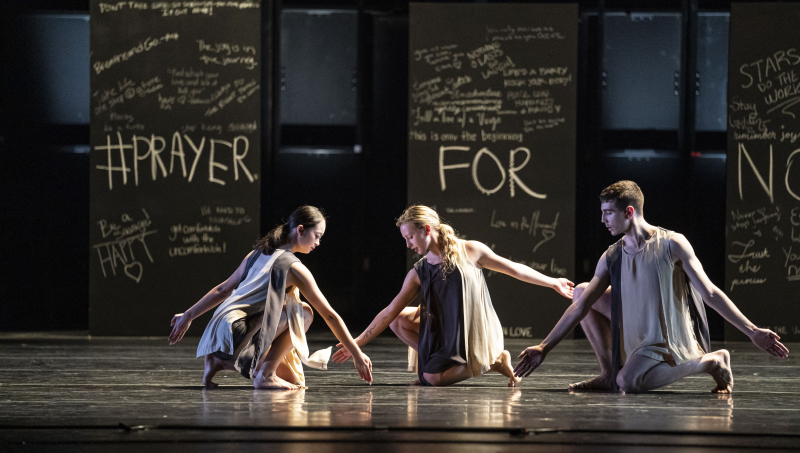 #prayerfornow by Stephen Petronio. © Todd Rosenberg Photography
#prayerfornow by Stephen Petronio
Finally, a piece for the seniors. #prayerfornow, created by Stephen Petronio, began with three dancers laying downstage, each placed far in front of narrow black chalkboards. In silence, three dancers emerged from the walls upstage and each wrote a word: ‘#prayer,’ ‘for,’ ‘now.’ Surrounding these bolded words were encouragements written by classmates, audience members, teachers. The entirety of the piece would be framed by these walls, the seniors moving in and through this world of support.
Petronio’s history as a Trisha Brown dancer was evident in the movement. The release packed a punch, pendulous in nature and quality. As the stage populated with dancers and sieved to just a few, I was drawn to the unpredictability of the spatial patterns. I could not predict what would come next, was intrigued by how the dancers continually found new pockets to populate.
The orchestral drone and bleakness of the grey costumes countered the supportive nature of the walls of encouragement which so warmly opened the piece. This juxtaposition perhaps spoke to the state of ‘now’ (perhaps why we need a prayer). I desire more in where this piece went. About halfway through there was a stillness that made me see differently – all bodies onstage, not moving, just being. Watching each of them move made me excited for where these seniors will go next – their skills and knowledge of modern dance strongly intact.
Part 2: Moving Forward
I am a huge proponent of dance in the sphere of education, a huge advocate for dance programs in universities, colleges, and conservatories as perfect training grounds for entering the ‘real’ world as both dancers and people.
This show allowed the opportunity to think not about curriculum, not about faculty, not about what pedagogies are used in the classroom. This show allowed the opportunity to watch the dancing, to think about the students, to think about their talent, curiosity, and intellect. Knowing these students are about to enter the ‘real’ world is exciting. Their talent is extraordinary; their performance ability uncanny.
I think back to the lobby, the way it buzzed with excitement and curiosity. I think about the way that same buzz was palpable on stage as well. A fervent excitement shared by students, faculty, and audiences alike. It is a privilege, I assume to make and to work in that large, deep sea of talent displayed on the Juilliard stage. Of course, an undergraduate setting provides nurture in the way the dance field doesn’t always. But this nurture is what jumpstarts the confidence to ‘make it work’ when they move forward. The skills they learn in this environment are irreplaceable. Group works with as large a cast as demonstrated this evening are rare outside of academia, but provide skills that fold into what is needed to work in more intimate processes – navigating space, personalities, creativity, confidence, and so much more.
I can’t help but think – this is a collegiate level show, but here people sit, right next to Lincoln Center, enjoying a professional level evening of dance. We are all excited for these dancers to enter the real world. But, when you think about the caliber of this show, the choreographers they worked with, the people in the audience – haven’t they, in a sense, already entered?
We are the better for it.
Phoebe Ballard is a movement artist, educator, and writer based in Brooklyn, NY. A teaching artist at Dancewave and public schools throughout the five boroughs, she hustles between different writing, administration, dance-making, and teaching engagements in NYC and NJ. She graduated from the University of Illinois at Urbana-Champaign in 2018 with her BFA in Dance.


 Life as a Modern Dancer
Leave a reply to Anne P Cancel reply