Tender Is the Day in “slow dark dances”
By Garth Grimball
“Anyone could do that.”
How many times has this dictum filtered into the air from an unimpressed observer to a piece of modern art chilling the room’s temperature like air conditioning out of a vent? I’ve heard it many times. My father said it about Cy Twombly. A college acquaintance said it about Mark Rothko. I don’t get annoyed. It can open up stimulating conversations if the unimpressed are open to it. Also, the observation isn’t wrong en toto. Kasper Bosmans’ “George IV Kilt Hose” (2017) is basically two socks laid on a gallery floor that can take up to a day to “install.” Sometimes an artist’s concept can be so large it swallows the form.
This isn’t the case with “slow dark dances” at the UC Berkeley Art Museum. Choreographed by Maurya Kerr, “slow dark dances” is a durational dance and film installation that “seeks to uncolonize the ‘invisible’ whiteness of museum spaces.” Seventeen dancers join Kerr in this 6 hours per day installation over the course of two weekends. I experienced it for 75 minutes.
In 1976, Brian O’Doherty interrogated the modern art white cube space in The Ideology of the Gallery Space. The white cube is not an impartial space, he argues. Its aesthetic is limiting. The reproduction of this aesthetic limits the experience of art around the world. Kerr and collaborators build “on legacies of Black joy as a form of resistance.” In “slow dark dances” the gallery space is not a series of white walls meant to serve as an invisible backdrop to art; the surfaces are included in an agitation of tenderness.
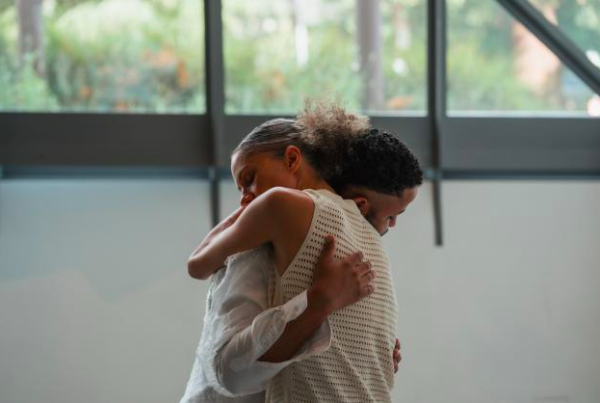
At noon on opening day eight dancers entered from behind the museum’s forum. Each one dressed in an ombre combination of ivory, sand, bronze and chocolate. They paired off and stopped in different galleries. They faced each other and embraced. From there the choreography was as simple as swaying. From there the choreography was as mutable as a butterfly’s flight pattern.
The four duets embraced in silence for an hour before being replaced by other pairs. The durational enfolding provokes the eye to zoom in on the multeity of touch. A caress of the spine. A thumb circling. Chin on shoulder. Lips to a collarbone. At one point a couple split open to switch from cheek to cheek and it felt seismic. The slow of “slow dark dances” slows the gaze to see more.
Alexa Burrell’s film screens in two galleries in the museum, accompanied by a duet in each location. The film is textural and sculptural. The dancers sway in and out of the frame. Skin, hair, the fabric of costumes, the density of the floor slowly collide and separate. Burrell steadies the view when the dancers inhabit embraces evocative of a pieta or a baptism.
The “simplicity” of “slow dark dances” belies its impact. The choreography interrogates and invites. Part of the choreography is seeing how museum-goers interact with the performance: look away only to sneak a glance; sit and stare; pass the duets on the way to the exhibit you're searching for. Each dancer’s commitment to sustained intimacy creates a vulnerability that feels biased to witness. Kerr pacifies this bias by inviting everyone to join in a group slow dance the final hour of each performance.
That’s the thing about dancing—anyone can do it.
Check out "slow dark dances" on December 10 and 11, 2022. Find out more details here on the BAM PFA website.
Garth Grimball is a dance writer and artist based in Oakland, CA. He is a contributor to the SF Examiner and Dance Media. He is the editor of ODC’s Dance Stories.


 Life as a Modern Dancer
Leave a reply to Brenda Way Cancel reply