In Duetrospectives Absence Makes The Art Grow Fonder
By Garth Grimball
Jess Curtis died suddenly two years ago. The influence and depths of his work will ripple across the ecosystem of performance and accessibility services for years to come. Before he died, he was planning to produce a retrospective of his choreography, specifically duets, called Duetrospectives. On May 28-30, 2026 at Joe Goode Annex, Curtis’s company GRAVITY, now co-directed by Rachael Dichter and Gabriele Christian, produced Duetrospectives, but rather than an artist revisiting his own work, the program was an artist being revisited through his works and the relationships made over decades of artistic collaborations.
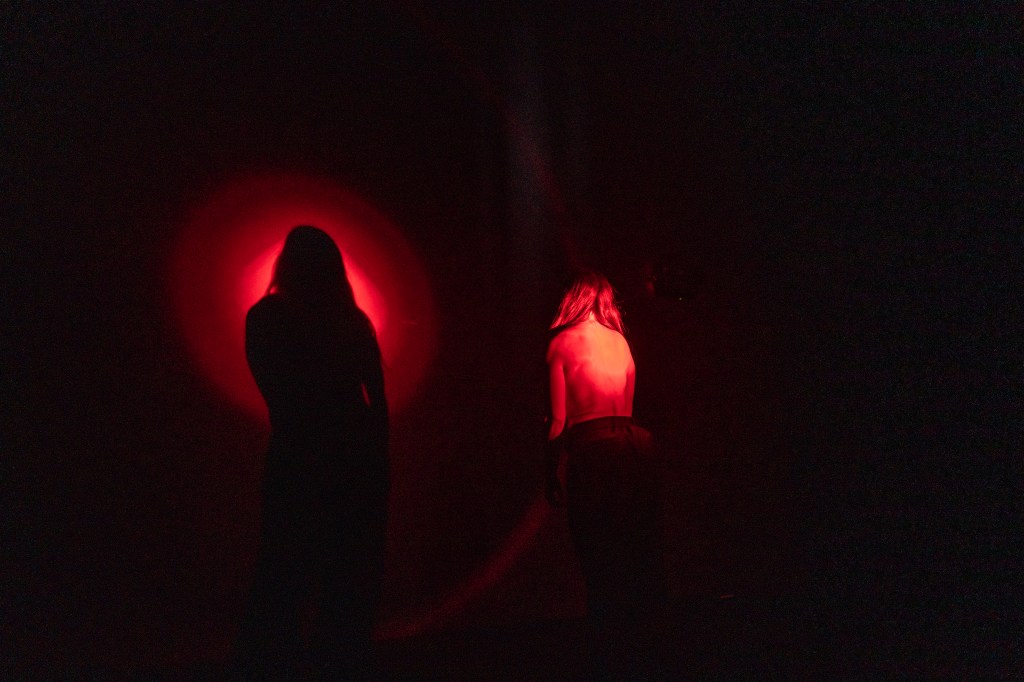
Five pieces with eight different performers re-imagined, re-staged, or relinquished Curtis’s oeuvre. Dichter and Claire Cunningham’s pieces were the most elegiac. Dichter’s You Used To Be Naked (developed out of When I think of you you’re naked and The Dance that Documents Itself) began with her topless in the dark. Abby Crain directed a red light onto Dichter’s body as she pulsed, shook, undulated and trembled. The tight focus of the handheld light abstracted the body into mini landscapes. Crain left, the lights turned on, Dichter changed clothes and made her way to a chair facing the audience. The harrowing experience of being absent from Curtis’s death and then present in its immediate aftermath was told with an extreme tension between disassociating and associating. Dichter seemed to be in front of us while telling the story, but also disassociated from us as she put herself back into an experience that was disassociating. The ill-shaped contours of grief and its wounds were present, unmitigated.
Cunningham and Curtis collaborated over decades and continents. Their show The Way You Look (at me) Tonight developed and iterated from 2016-2023. Cunningham is based in Scotland and in lieu of a live performance she created a textual-audial short film. Walking/On uses recordings of Cunningham, Curtis and philosopher Alva Noe voices from a 2016 performance of TWYL mixed with Matthias Herrman’s sound score. The film is a black background with white text that appears at the speed of the speakers’ voices across different parts of the frame at varying sizes of font. “I walk my desire lines on you,” said Cunningham. “Could they be dancing?” asked Noe. “We go another way,” said Curtis. The overlapping voices and Cunningham’s descriptions of her actions while she danced with Curtis forefronted how touch informs memory. A familiar touch cannot be recreated; its absence has its own feeling.
Sherwood Chen’s See What You Say was a kaleidoscope of process and processing. From Curtis’s Touched: Symptoms of Being Human (2005) and Fallen (2001), Chen iterated loops of choreographies and methods. He skittered across the stage dressed in white emitting an occasional vocal noise. Prostrate on the floor, he wiggled downstage by pulling himself from his legs (a motif throughout the piece). Curtis’s voice came through the speakers. Chen described a rehearsal process with Curtis and then performed an audio description of choreography, he on the opposite side of the stage from a spotlight in which the action described would occur. Footage of a car stuck in a river and its removal were projected as Chen danced, spoke and read a letter. See What You Say ended with Chen putting on a dress over his clothes and repeating a phrase – front turn, flip-hop over the right shoulder, back turn – before a final statement: “It is enough.”
After Symmetry, choreographed by Maria F. Scaroni and performed by Scaroni and Stephanie Maher, and Not A Prayer, choreographed by Curtis and performed by four of its original cast members, focused on Curtis’s choreographic craft.
The Symmetry Project, developed between 2007-2011, by Curtis and Scaroni featured “two naked bodies interact[ing] through a structured improvisational score.” Sex & Gravity, from 1995, was a collaboration between Curtis and Maher “to render their intimate life transformed by radical sexual (and political) exploration” of their artistic milieu at that time. In After Symmetry a mass of foil surged out of the upstage right corner like SF’s famous fog. Scaroni and Maher stood naked facing each other, in profile to the audience, and performed an improvised score of counterweight, intimacy, extremities, care, and in one instance, spanking. This score interrogates as much as it performs. What is vulnerable? When are bodies erotic or clinical? What makes a spectacle spectacular? Scaroni and Maher’s concentration and trust grounded After Symmetry in a lineage of risk taking and experimentation. Their nudity and intimacy did not feel like an easy provocation but an exploration rooted in dedicated art making.
Duetrospectives closed with the re-staging of Not A Prayer, choreographed in 1995 for the Men Dancing Festival at Theater Artaud. The quintet was performed as a trio by Miguel Gutierrez, Dylan Skybrook, and Vong Phrommala, with a music score by Mark Growden. The choreography is a time capsule of 90’s release technique. Two record players stood upstage as one dancer laid down center stage. The other two dancers would fling, roll, or drop into configurations around the sprawled one and then shift positions. From the floor solos, duets and trios developed and transformed over repetitions. Growden’s score involved a boombox, metronomes, live saxophone, and music boxes interrupting and overlapping at different points. The dancers threw limbs, spoked distal ends into space, traveled as if there were a wind at their backs. It was a gift to see the original cast. In their bodies was the sense memory of making the work together with Curtis, of making and performing all the works they have been a part of since, and making something new 31 years later, without Curtis, but still very much dancing with him.
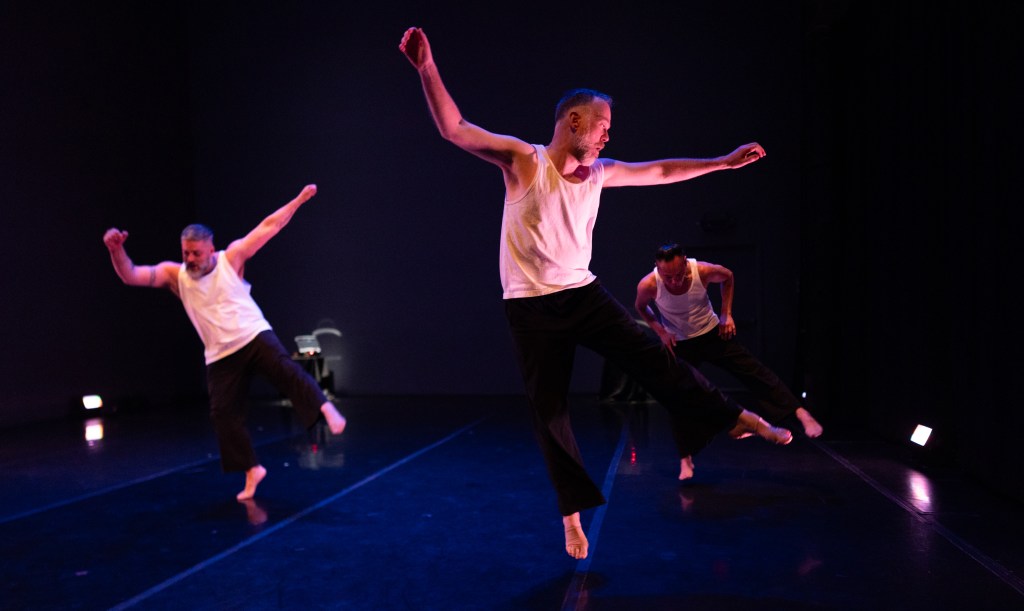
Photo by Robbie Sweeny. Image description: three dancers in white tank tops, black pants, and bare feet. Two are captured in motion with arms outstretched, and one leg off the ground and swinging to the side.
Garth Grimball is a writer and dancer based in Oakland, CA. He is a regular contributor to Dance Media and SF Examiner/Nob Hill Gazette. He is the editor of ODC Dance Stories.


Leave a comment