*This writing was originally published on September 28, 2026 on the pateldanceworks website. Shared here with permission by the author.
Turning Toward Exquisite Attention by Bhumi B Patel
I’ve been thinking a lot about the many times protesters have used mirrors facing the aggressors as shields so that those approaching front lines of protestors would have to face their own images, and by some measure face the image of their aggression. Is this quiet action passive? Does it render the protestor inactive?
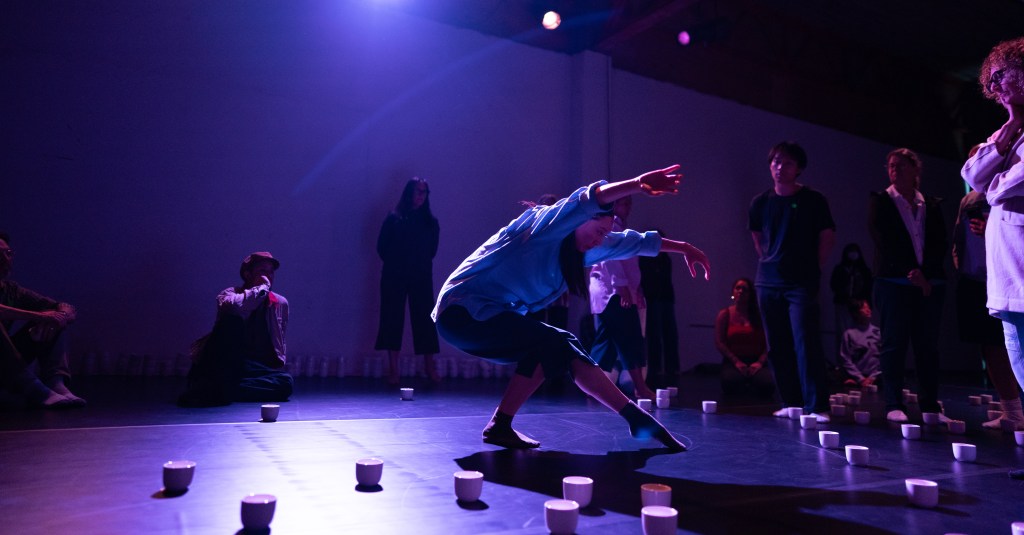
On September 20, 2026, I attended SanSan Kwan’s How To Make A Passive Dance at iMPACt Center for Art & Dance but felt more like I was being invited into an intimate space, maybe even someone’s home. I took my shoes off and was shown where to place them, asked if I was okay with participating, given a sticker to place on my clothes to signal my answer, and then I wandered into the space, making my way through a maze of scattered white tea cups that covered the floor. I felt like I was making my way through a field of delicate flower blooms. Chairs lined three sides of the space, and words were projected onto the wall of the fourth side: Breathe; Attend; Receive; Listen; Meet; Allow; Surrender; Abide; Attune. I wondered if these were instructions for me, or the dancers. Or perhaps both.
The title of this work reminded me of Lorrie Moore’s 1985 short story “How to Become a Writer,” a wry guide on how to, you guessed it, become a writer. But here, Kwan defied my expectations. In the program, Kwan makes the provocation that “Asian Americans historically have had a fraught relationship with passivity, but might there be reason for us to reconsider qualities like deference or restraint? How to Make a Passive Dance explores how dance – a medium defined by embodied action – can serve paradoxically as a space for exploring inaction.” I wonder if inaction, though, is a form of action in itself, like the protestors wielding mirrors in the face of tear gas, batons, and water cannons. Dance is, after all, in the words of Rosemary Candelario and Matthew Henley, “a product of human culture, a creative practice, a physical science, a mode of expression, and a tool for knowledge generation.” Practice, expression, generation – all of these works evoke action in me.
Kwan comes into the space and the performance begins. She asks “What happens when you pay exquisite attention?” And then, over 55 minutes, the audience is asked to do just that. Dancers enter in button down shirts and loose pants, their hands clasped behind their back in what, at least in my family and community, has always been called “the Asian uncle walk.” Their gazes are lowered, the sound, by Bay Area composer Ben Juodvalkis, is atmospheric, and the dancers wander. They find each other and hold hands. They walk together in what appears to me to be a meditative state.
Soon, the dancers begin approaching those of us in the audience to invite us into the space. They tell us that we can explore. Some of us walk slowly while others sit. Some lean against the wall while others take one lap and return to their seats. Others still lay down and get up and rearrange themselves multiple times, truly taking the invitation to explore the space. Each dancer, one at a time, began a solo in a pool of light, and depending on where you were looking, not everyone saw everything. These short solos swirl and glide, each dancer moving fluidly through their bluish pool of light until it fades away. But then something shifts and the dancers began moving together, more playfully and more attuned to one another in duets and trios, moving the cups, stacking them and shifting them around the space, the satisfying tinkle of cup on cup adding to Juodvalkis’ layers of atmospheric and natural world sounds.
The word passive stayed in my mind as I watched the section of duets where the dancers appeared to be controlled by puppet strings, and I wondered about the agency in allowing oneself to be led. Perhaps being led here is a refusal to repair the image of the obedient, ornamental Asian woman (to borrow from Anne Anlin Cheng). Perhaps it is an antireparative turn, where the reparative acts as a form of obedience and discipline toward the normative, where the normative is actually the act of violently thrashing against stereotypes through action that feels more like a performance than stillness or quite.
The dancers asked everyone who remained in the space to return to their seats and began a bleak, frenetic series of tableaux, some of which would begin quivering then violently shaking until they broke away, like the dancers, without the embrace of the audience on stage with them, got stuck in a machine. Eventually, the dancers slow to a gentle sway, like trees in the wind, while Kwan reads an excerpt of “An Orange, A Syllable” by Gillian Sze to close the piece. The lights fade, the stillness settles, and I could feel the audience take a breath. Maybe that’s what happens when we pay exquisite attention. We find breath.
Dr. Bhumi B Patel (she/they) is a queer home-seeker and science fiction choreographer, director of pateldanceworks, and writer. Patel tends to her desires to create liberatory, nourishing community spaces through dancing, choreographing, curating, teaching, and scholarship and has presented her scholarly and performance work nationally and internationally. Patel serves as Editorial Assistant for Choreographic Practices and teaches dance practice and dance studies in higher education. Bhumi’s research on queer decoloniality and improvisation intersects with her performance-making as a way of tracing the deep connections of past, present, future to build communities of nourishment and care.


Leave a Reply