In View: Carmina Burana with Dana Lawton Dances
By Jill Randall
Grace Cathedral, San Francisco
April 19, 2026
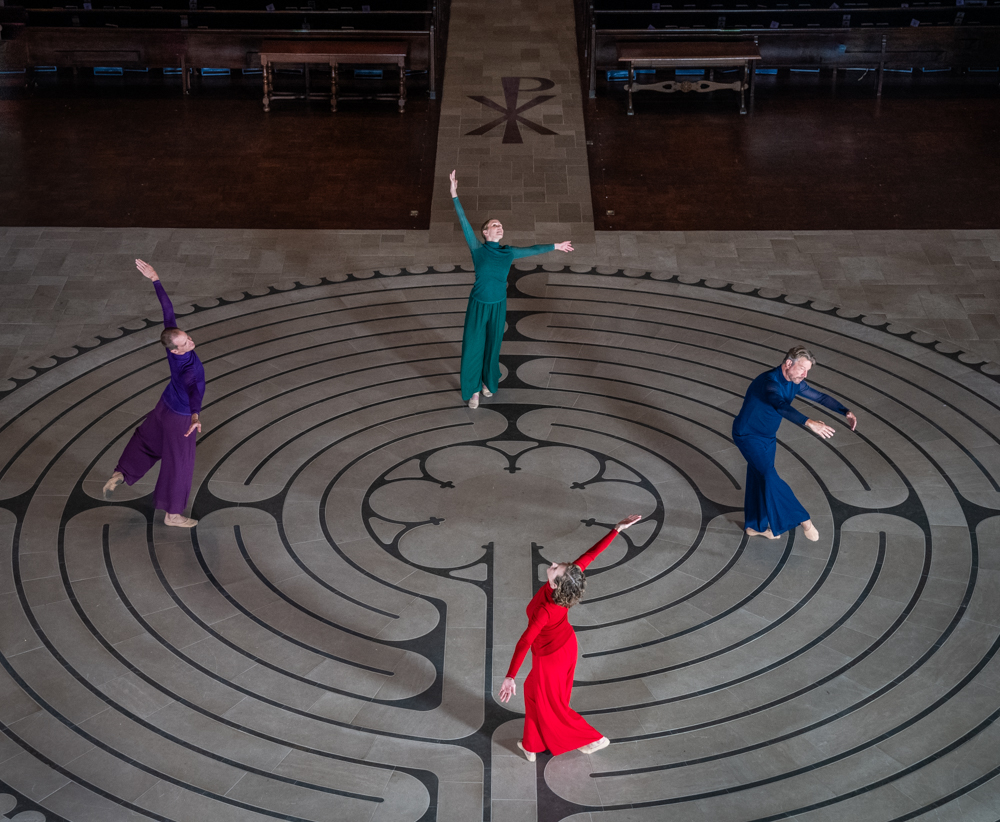
A year ago, I got to witness Dana Lawton Dances’ premiere of Carmina Burana at the Grace Cathedral in San Francisco. That was only my second time ever at Grace, so there was much to see/hear/feel with that full experience of dance, music, architecture, and spirit in such an incredible, grand space.
The opportunity for a second view of Carmina Burana – a second encounter – is a gift. I loved being there again one year later on Sunday, April 19, 2026 for the 1:30pm performance.
There is an added ease and comfort knowing the space, duration, and general feel for a piece. This time I sat in the front row of the in-the-round seating. I took in the labyrinth and feet on this floor pattern and had numerous beautiful moments within a few inches of the ensemble.
Choreographer Dana Lawton provided a perfect set up for the performance in her introduction. She was warm, present, and clearly shared that it is a non-narrative dance and to experience each section as a response to the music and each as its own vignette. I felt at ease, since I have little prior and contextual knowledge about Carmina Burana.
The music starts off with a combination of grand, booming orchestration and whispered, intriguing singing. Is the singing in Latin? The cast of nine comes into the space cloaked in black velvet robes. This time around, I catch the costume reference, to the large wooden statue just a few feet away from me in Grace Cathedral. The dancers’ gestures are invitations towards connection and meaning making. They hold, point, enclose. The gestures are sacred + old, universal, and abstract all at once. In particular I am drawn to the cupped hands in front of the chest. They are parenthetically capturing a thought; they are a chalice; they are holding an energy that is powerful and grounding.
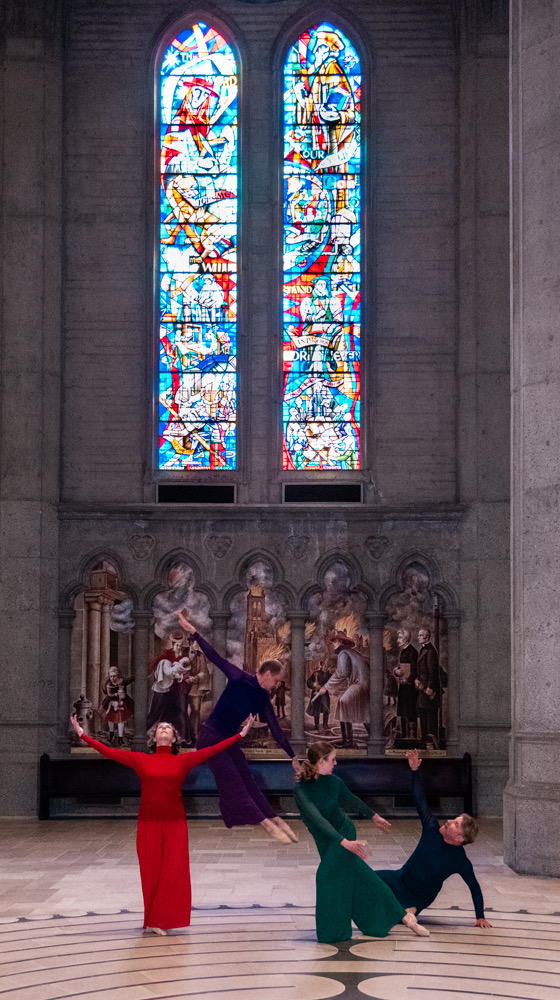
As the dance continues over 50 minutes through multiple sections, the cloaks come off to reveal monochromatic costumes of long sleeve fitted shirts and flowing pants in colors matching the stained glass up high – purple, blue, red, and green. In addition, as Carmina Burana progresses, I see the journey of the dancers from serious faces and an internal focus, to connecting with each other, to softening expressions and even moments of humor. I appreciated following this energetic trajectory alongside them.
I want to take a moment to talk about the audience being in the round. I was equally delighted in this daytime, day-lit performance and seeing other people around the circle experiencing the dance too. I enjoyed catching a moment of Dana Lawton – also watching, enjoying, and appreciating from the audience vantage point. In phenomenology we talk about intersubjectivity and the performer/audience relationship; can intersubjectivity also describe the audience member-to-audience member connectivity?
The dancers all perform Lawton’s choreography well – the clear timing of the phrases, the range from small gestures to extended arms, to swivels and hops and partner lifts. One year later, you feel the settling into the choreography. Everyone’s feet feel a little more on the labyrinth, and spines and heads lift upward to the vaulted ceilings.
A particular standout moment for me was in the middle of the dance: Aaron Draper and Garth Grimball’s duet. The rest of the cast clears and our audience focus telescopes in to these two dancers. And at the same time, I am able to also see/experience the floor, the circle of guests, and the walls of the cathedral. I clearly can simultaneously see dancers and space, together. The duet has a lot of play and athleticism. I remember them propelling each other into horizontal X leaps several feet off the group; I remember joyful hops and sautés circling the performance space with power and also with release.
Choreographically, I appreciated the vignette format and the range in tone and form – from ensemble sections to solos and duets, to solemn contemplation in this sacred space, and then even a few moments of play and humor. A vital shift for our times. Dana excels at the clarity of line, direction, and rhythm. Specificity and timing are always prioritized. She beautifully brings the music into 3-dimensions and invites a modern connection to a piece of music nearly 90 years old.
Dana Lawton Dances’ Carmina Burana at Grace Cathedral affirms what I love so much about the power and potential of dance experiences: coming together, a time of solace and reflection, the celebration of the human body in motion and its expression, and creativity and non-linear thinking and imagination. Hope/beauty/joy/grounding/connection.
Thank you Dana Lawton and dancers for a beautiful Sunday afternoon together in real time and space.
Jill Randall is the founder and director of LIfe as a Modern Dancer. She also writes for Stance on Dance, Dance Teacher, and Dance Magazine.


Leave a comment