Moving Alone and Together in Pei-Ling Kao’s EPIC
By Max Winig
EPIC, a 2026 dance production by Pei-Ling Kao in collaboration with Sunny Nai-Hsuan
Yang, looks at the relationship between chaos and order. Blending Kao’s expertise in post-modern dance with Yang’s hip hop prowess, it explored themes around individual identity and group belonging through a complex web of improvised and choreographed movement. EPIC exceeded my expectations in every way. The sheer volume of material packed into a single hour highlighted the individual strengths of each performer, as well as their ability to seemingly think as a single unit. Every night offered a completely different experience. Each viewing revealed compounding details within the structure of the work, and how all the fun onstage pointed to underlying themes.
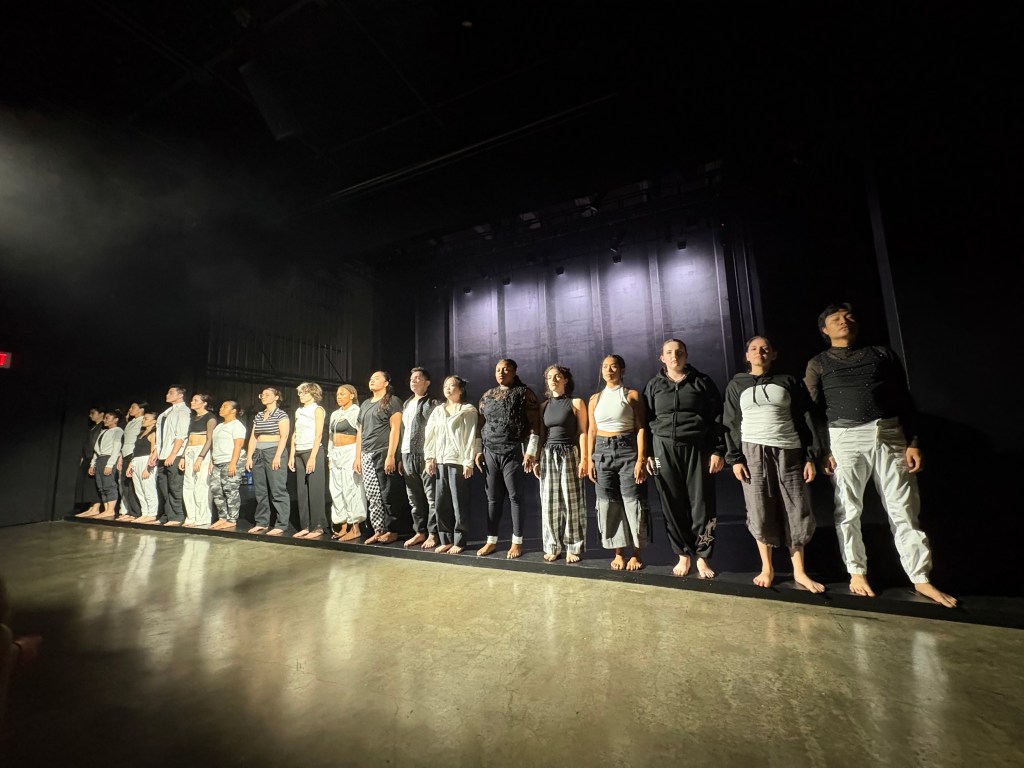
Though EPIC is advertised very colorfully, it begins in black and white. The exposed
back walls of the theater, paired with sparse lights shining through the haze, creates a feeling of being in a back alley. Ella Raitano’s masterful lighting design transports the audience to the world of the performers, where meaning is developed through movement. The soundscape by Jun-Yi Chow relies on everyday sounds, often occurring at a distance. As the cast of twenty explores the space, they are accompanied by the sounds of birds, cars, beeping, laughing, and rushing water. Each dancer is individually styled, with different hairstyles and patterns and types of clothing, moving in their own ways across the stage. However, the overall black and white aesthetic still creates a cohesive effect.
In this first section of the performance, the dancers are neutral but attentive. Patterns are created only to be broken. Pedestrian movement blends into several different styles of dance. Connections are formed, experienced, and left behind. An improvisation score brought people from their individual explorations to larger group arrangements, as the dancers found new ways of relating to each other, the space, and the music. On Friday night, one performer led a solemn conga line around the stage. On Saturday, another was rolled across the floor by a group of performers until she was helped to her feet. On both nights, Les Petites Choses Production guest artist Yi-Ru Chen appears in various places across the stage in a pigeon mask. It is deceptively easy to miss the pigeon standing nervously in a corner, or dancing along the back
wall, when so much else can draw your attention..
In a moment of silence, the dancers come to a circle. Without the driving force of the
music, their pace is dictated by each other. Unison is found through breath cues and the sound of footsteps. The dancers gather in a line at the very front of the stage to stare into the audience, before dissolving this shape to form the same line facing away at the back of the stage. The music then returns with a faster and heavier beat, alongside unison phrasework from the dancers that demonstrates a shared musicality. Suddenly, one person spasms to their feet while the rest of the cast holds the beat on the ground. Two women pose together, drawing on their shared experience in classical Chinese performing arts. From unison, we have moved into individuality, highlighting the specific skills each performer brings.
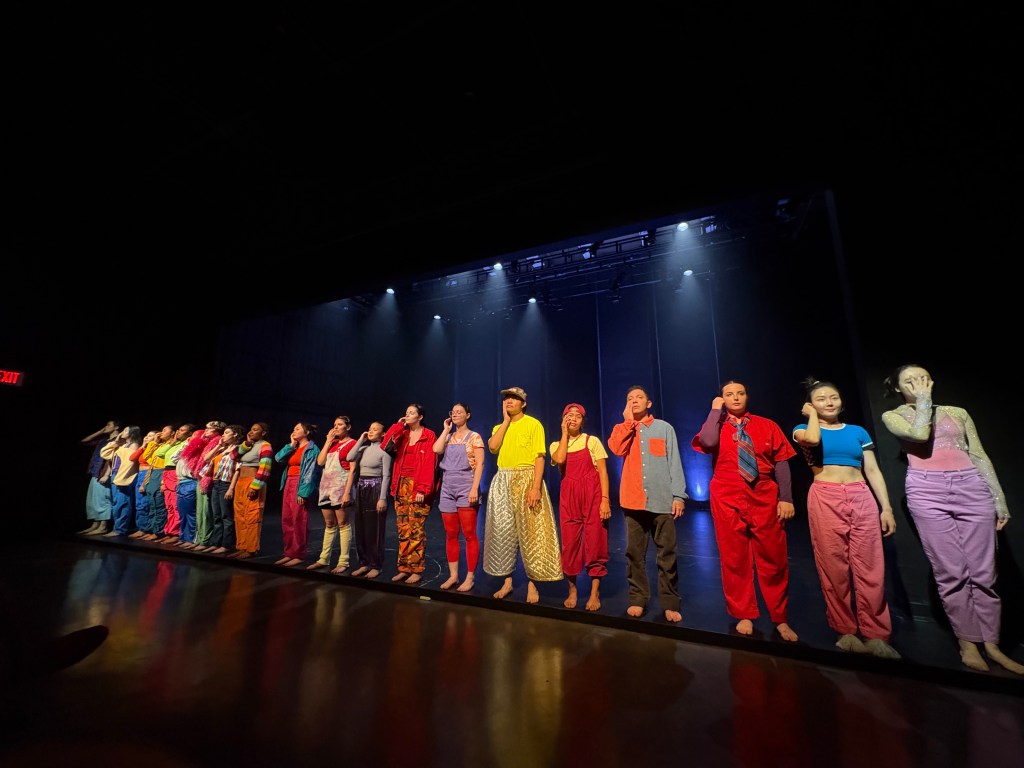
As a group of dancers silently parties in the center of the stage, colorful clothes are
tossed towards them from offstage, landing in piles around the dancers. Calmly, a dancer walks onstage with a large briefcase filled with more clothes; the performers crowd around her, selecting certain items for themselves. Onstage, the cast changes from their black and white outfits into bright colors, piling their old clothes in the corner of the stage. Once the change is complete, the briefcase is closed and the dancer exits as the curtain closes. With the curtain closed, LPCP guest artist Le Shen performs a monologue in English, while Yi-Ru Chen seems to shine a flashlight right through him. Though the sentences seem largely unrelated and humorous, they also reflect the time that LPCP has spent in Hawaiʻi, and how identity is performed in a foreign place.
The second half of the show is choreographed by Sunny Nai-Hsuan Yang, the Art
Director of Les Petites Choses Production (LPCP). Though visually and sonically very different from Pei-Ling’s choreography, it deals with many of the same themes: individuality and conformity, silence and noise, connection and distance. Ella Raitano’s lighting and Pi-Hsin Chiu’s sound design brings us into a colorful nightclub environment, where a myriad of sights and sounds support the energetic movement happening onstage. The performers bring their own dance styles into the space, while also finding moments of choreographed hip hop unison, grooving as one. Though everyone approaches the movement in their own ways, they are unified by their musicality, just as in the first half.
In a chalk circle at the edge of the stage, four dancers gather for a cypher while the
remainder of the cast crowds around them at the front of the audience. Every night, a
completely different playlist soundtracks this segment. At first, the featured dancers stand awkwardly, avoiding each other’s gazes and the excitement of their audience. But when the music changes, the dancers are free to express themselves to the music when they choose to, with hip hop freestyle that demonstrates the talent and experience of the cast. The observing performers cheer them on with contagious energy, mimicking their movements and keeping the groove going, even when the circle itself is empty. Though the awkwardness expressed by the dancers is entertaining as comedy, it also points at the vulnerability that is involved in self-
expression.
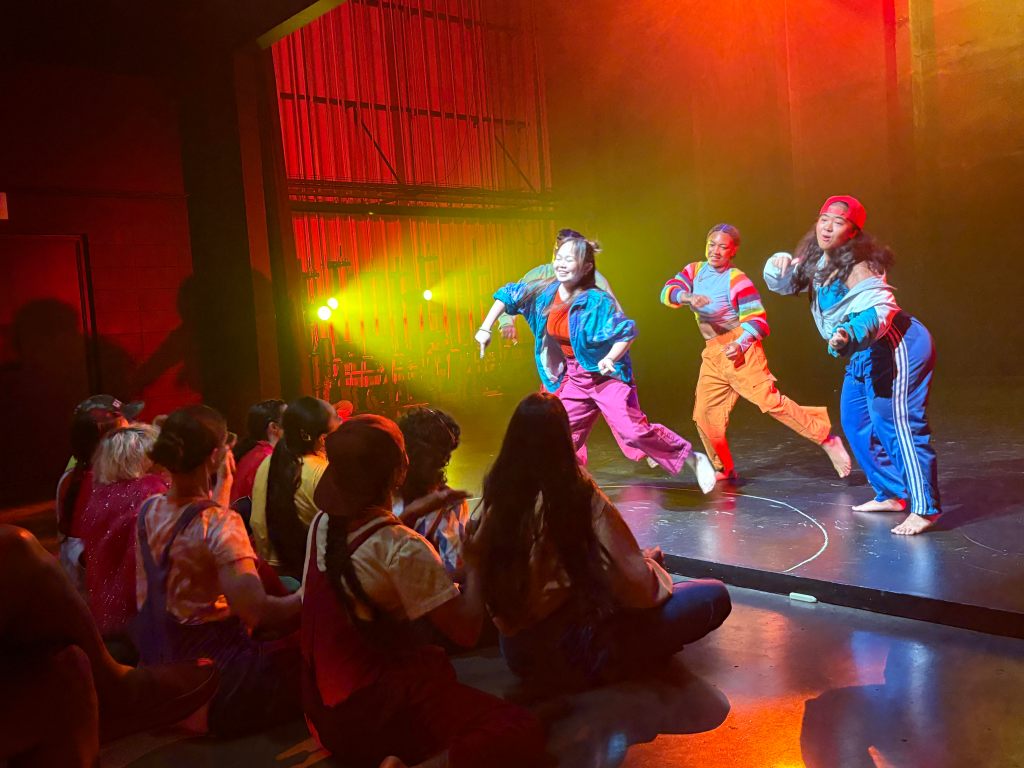
A later cypher has a similar set up, with the cast circling to hype up a previously featured hip hop dancer. However, instead of the movement we’ve previously seen from her, she opens this segment with hula. Every performer enters the circle with their own specialty: ballet, contemporary, acrobatics, jazz, hip hop, and more. The rest of the cast responds to each performer with genuine excitement (especially for Madison Audette’s slow motion entrance). Individuality, in this moment, is what makes each performer interesting. Their cultural backgrounds inform how they approach the space of the cypher, and how they choose to present themselves and their dancing. Lahikiola Kailihiwa ends this cypher by pulling everyone else in towards her for a shared party; on Saturday, she initiated a group macarena.
In this production, magic is found when the performers convene, and in all the ways their different cultural and artistic backgrounds create new possibilities. But at the end of the show, the stage is left empty, with hazy spotlights illuminating the center of a black room while a start-of-show announcement plays over the speakers. Connection, in EPIC, is transient. The improvised moments of collaboration are gone as soon as they happen. The joy found in dancing, both together and alone, is tempered by the loneliness felt when forming and dissolving these connections. The announcement ends by saying “the performance will begin shortly.” EPIC posits that this is where the true performance begins: not in this hour in the theater, but in everything that follows.


Leave a Reply