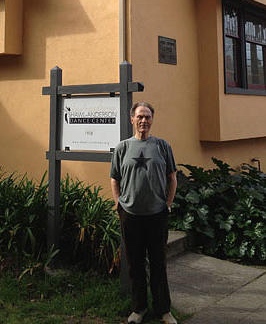
Co-founder Frank Shawl in front of the Center
Intergenerational Contemporary Dance: Training, Rehearsing, Performing and Learning
Shawl-Anderson Dance Center (SADC) was founded by Frank Shawl and Victor Anderson in 1958. Shawl and Anderson set out to create a home for dance in the East Bay modeled after the heartfelt approach of their Sacramento-born, NYC based mentor, May O’Donnell. SADC is a non-profit educational and performance space that has evolved into a model ecosystem of art and community that empowers people through their moving bodies. Dancers ages 1.5 to over 80 years of age share the former residence-turned-dance center each week in classes, performances, movement experiments, rehearsals, residencies and more. SADC is committed to nurturing and mentoring the growth of dancers and choreographers; cultivating a healthy and supportive atmosphere for creative expression; sustaining traditions essential to excellence in the field; and, fostering the evolution of the art of dance. Rebecca Johnson was the Managing Director from 2008-2014 and became the Executive Director in 2015. She is honored to serve alongside her colleagues as the next generation of leadership for SADC and the community.
———–
By Rebecca Johnson
My ballet career wrapped up around the age of 13. I trained for five years in a Royal Academy based ballet school and went on to take classes at Boston Ballet, where I realized that the doors to becoming a ballerina were not going to open for me. My jazz teacher at the time suggested I check out company class with a small modern dance company in the suburban neighborhood the next town over. I did, and within a week I found myself training and performing with this company of twenty and thirty something dancers at the age of 14 in Framingham, MA. This first foray into an intergenerational dance setting was powerful on many levels. I grew artistically and technically and the support, camaraderie, and role modeling offered by my fellow dancers was critical to my development as human and dancer. They allowed me to see past the limitations of high school into a future where dance could become a seamless part of life. Even during college I gravitated away from the homogeneous environment of the dance program towards a company outside the university that involved dancers ages 12 to over 40 years of age.
Fitting now, though perhaps not surprising, that I find myself 30 years later at the helm of an organization that reflects this lifelong love of dancing, training and performing in an intergenerational setting. Pursuing this work in a setting where dancers of several generations are moving together supports a diverse perspective on learning. When we are 25, a battement means something different than when we are 45. It has a different value – a different meaning. As younger dancers our intention might be about the height of the kick and the athletic "wow" we can make our audience feel. In our 40s we might be asking different questions about that kick, expressively and technically. We might be wondering about our standing leg, where we are looking, how carving space as the leg makes the way back to the floor can bring our audience on a different ride. The experience is infinite. What is this battement today? As we practice together in the room, multiple experiences of learning are witnessed and applauded. Our perspective on error and success becomes blurred in a way that challenges and invites us into real-time movement inquiry.
Sometimes dance in a homogeneous environment makes sense. If sameness of training, exactness of expression or cultural ritual is the goal, then the benefits of that kind of training can be very powerful. If we think in a broader, post-modern or contemporary sensibility, we might see dance as an expression that connects humans in infinite ways. In this case the benefit of learning from one another through different stages of experience, as we do in our lives, is an invaluable tool and a deep-seated vehicle for transformation. We move fluidly between the roles of teacher and student, audience and performer. And dancing in an intergenerational setting does not preclude deep connections with dancers of our own generation. It contains that experience and allows individuals to become more collectively connected to their generation and see and talk more clearly about what we are learning from seasoned and up-and-coming generations.
Dance is learned in real time – the knowledge, technique and wisdom transferred only by being in community, in the studio, with others. Sweating, bruising, touching, thinking, seeing, navigating, flying [insert your own verbs]. We learn the dance by being with those new to the work, with those who have a mastered the work and with the bulk of us in the big middle, riding a personal trajectory that allows life and dance to become seamless in the lessons it has to teach us.
—–
If you were a former student at Shawl-Anderson Dance Center and want to reconnect, you can email Rebecca at rebecca@shawl-anderson.org or visit our website at www.shawl-anderson.org and click the “join mailing list” in the upper right hand corner.
——————-


 Life as a Modern Dancer
Leave a reply to joan lazarus Cancel reply