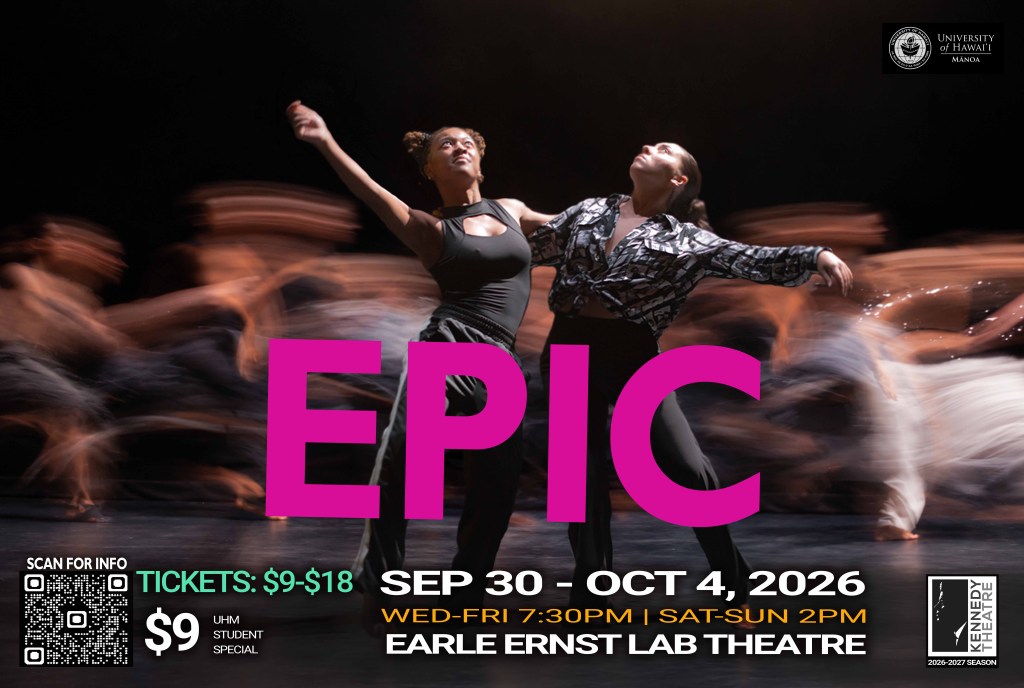
EPIC
Choreographed by Pei-Ling Kao and Sunny Nai-Hsuan Yang
Performed at the John F. Kennedy Theatre, University of Hawaii at Manoa
September 30 – October 4
Reviewed by Lisa Fay
EPIC is an offer of radical hope.
From the moment that the house lights dim and the land acknowledgement statement is re-presented – not repurposed, but intentionally and carefully re-presented through a
different cultural lens, we understand that we are being asked to re-consider what we
know about dance and how it is that we know it. What is dance, where is dance and
who are dancers? When is dance? Non-trivial questions with clear resonance beyond
dance, these are dauntingly huge transcultural questions and at the same moment
deeply embodied, achingly personal, questions of cultural presentation and re-
presentation. EPIC. This choreographed drawing attention to of prevailing, often
institutionalized, dance conventions is a key element of this piece, returned to over and
again as we journey through this cross-cultural collaboration – it is key to opening
alternative ways of knowing.
There is a politics to choreographing the viewing experience for an audience – how and
what we watch. Where our attention is drawn. Where it is held. EPIC begins with an
invitation to us, the viewer, to make these decisions for ourselves. It hands us back our
autonomy and in so doing we ground ourselves in our own dance of seeing. We watch
the ebb and flow of dancers coming together and moving apart. Trailing, lagging,
striking out on their own. Traces of contemporary dance, ballet, and ballroom are sliced
through with an intense moment of Butoh. Within the austere black and white costuming, beautiful stark lighting, and delightfully delicate pulsing electronic sound-
track our eyes drift across the space making connections, tracing pathways, following
phrases, asking questions. Wondering. The dancers know what they are doing – they know what they are doing as dancers beyond technique and genre. Exquisite. Ease.
We, as viewers too, are being asked to participate in the making of this dance – piecing
together what we take in. Out of nowhere, in complete synchrony, the space sizzles
into a momentary charged stillness. Releases. Continues. And it is in this synchronous
moment, that as viewers, we are jolted into the realization that we are in playful
conversation with the dancers and the choreographers. That we, the viewer, matter to
the meaning making of this piece, EPIC. We think we hear a vacuum and see a light on
the floor, a figure emerges, vacuuming, and understand that any meaning making will
also be lodged in the absurd. We start to find patterns in the shifting grids the dancers
inhabit and the relationships they form. This too is preparation, teaching us how to see,
for the unfolding journey ahead.
The piece begins to shift from an austere, unmoored space to what feels and now
sounds like an urban cityscape, a market grounded in street sounds, voices, vehicles.
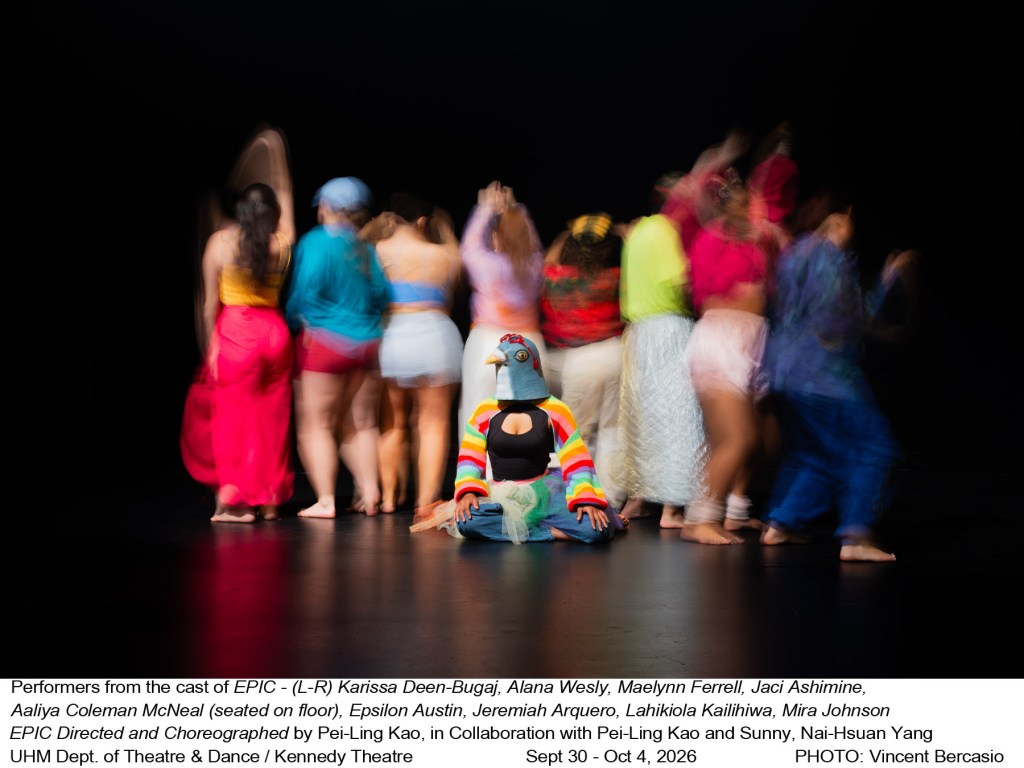
Lights shift saturating the space in color. Bright clothing is dropped onto the stage. A
performer enters, carries a suitcase, opens it and lets the contents spill out. More
clothing. The 20 or so dancers fill the space dressing themselves in these colorful
cheeky clothes, discarding their black and white clothing and exiting the space. And
before our very eyes the space is transformed. An irreverent clash of color and style.
The performer with the suitcase, alone now on stage, beautifully, simply holds the space as she finishes dressing in red and closes the suitcase. And in this powerful moment made only of the quotidian wed to the performer’s clear and committed presence, we are asked to consider that the simplest pedestrian movement might also be a dance.
And now the piece really takes off. Tightly choreographed duets give way to boxing.
Solos reveal themselves moments later as parts of a trio. Our eyes move as if we are
trying to orient in an unknown place. We hold on to a familiar movement. The moment
we think we know where we are we are whisked away by a group of dancers carrying
our focus off stage left with their clear synchronous driving movement. The range of
pure movement in this piece is nothing like I have witnessed – and it is nothing short of
radically hopeful. Traces of Jingju, House, Waaking, Hip-hop, Ballet, Butoh, Ballroom,
Hula, Cheerleading, Jazz, ‘Ori Tahiti, Modern, Contemporary, Afro, Siva Sāmoa, interlace asking to be seen anew, asking also to stay rooted. It is as if one is witnessing all of the dance pieces that have been performed in the lab theatre over the years at once – as if there is a temporal, historical depth in this singular moment of viewing – of now. And it is just about at that moment that a performer enters as a pigeon ushering in the absurd. The curtain closes.
We are offered an intermission by way of a performed interlude – an offbeat and inviting
curious little monologue is performed. Lit by another performer with a flashlight, it is a
one-sided conversation, his personal intimate introduction to us, the audience. Our eyes rest. We laugh. He walks into the audience offering lollypops and small talk. We take in the space. We are reminded that we are here, in the theatre. We watch him sit. We are ready to continue.
The curtain opens and the EPIC journey begins to sweep us up again. The intensity of
the piece is now ramping up. Dancers enter with headphones on in rhythmic
juxtaposition to the music heard. In shifting delignated spaces, solos drawn from
movement vocabularies across the globe are performed in rapid succession. In tight
juxtaposition, they seem to revel in their dissonance. These small dances give way to a
dance off, a dance off turns into a playfully competitive dance circle as live vocalizing
teases out and encourages each set of entering dancers, all now with a pulsing West
African influenced drumming track. A dancer, whose back handsprings the circle cannot hold, takes her turn outside the circle. Unrelenting, the piece shifts now, and for the first time in this 60-minute work, fully into unison movement. Plucked from different cultures, genres, and traditions, movements that we can’t quite name, now slam together and we feel the intensity of the dancers, of dance. We witness the powerful transcendence of energy from within singular bodies become the formidable, fierce energy of a body of dancers. We watch for the first time the same finely patchworked movement scattered across different bodies. In this profound moment, instead of trying to make the dancers the same in our eyes, we notice now slight differences. We see difference. Unison now arrives in quotes. And this too is an offer.
The piece disappears before our eyes. And just like that the dancers re-enter for their
bows. Not a continuation of the piece and yet a continuation of the piece we are
reminded of the convention of the bow, it’s history. And it is in that moment that the
dancers turn the heads, one by one, down the line, making full and complete eye
contact and we see their deep humanity. This piercingly tender moment, made of the
epic journey that ushered it in, holds radical hope.
EPIC unfolds before our eyes not only as a transcultural wayfinding but as a trans-
temporal wayfinding – not just where are we but when. As Qi Zhang, a traditional Jingju
(Peking Opera) performer who began her training at age 7 and now with years of
experience that includes the National Peking Opera Company so clearly states, “I
intentionally broke away from Jingju’s traditional rhythmic structures and incorporated
the movement vocabulary of modern dance;” this “created a dialogue between traditional Jingju aesthetics and modern dance, exploring the dynamic relationship between tradition and modernity.” Anjanaé Hassell, whose dance background includes Hip Hop, Afro, Siva Sāmoa, ‘Ori Tahiti, and Contemporary, says that she, “trained in many different places, trying to connect to my cultural backgrounds through dance.” She took this temporality in an opposing direction reflecting that “I normally see improv in a contemporary form but who says that improv belongs to a certain dance form?”
Directed by Pei-Ling Kao, choreographed by Pei-ling Kao and Sunny Nai-Hsuan Yang,
and developed with the performers, EPIC is exceptional in its choreographic prowess.
Embedded in the choreographic process is a clear grappling with the theatricality
needed to make the piece reverberate with an intelligence born of embodied ethics. It
harbors humanity. It knows what it is doing.
Channeling the energy of the dancers the piece held the capacity to lead us through
deliberate uncertainty and uncharted territory – to ask. To unmask our lived daily cultural chaos, and it asks us to be present with that for 60 minutes to see what might arise. To re-consider.
EPIC’s deep artistry lies in the willingness of the artists to vulnerably reside in the not
yet knowing and inviting us along for the precarious ride.
Days later and I am still smiling.
Cast:
Jeremiah Arquero, Jaci Ashimine, Madison Audette, Epsilon Austin, Victoria Beckett, Yi-
Ru Chen, Lilia Crabbe, Karissa Deen-Bugaj, Seleena Drummondo, Maelynn Ferrell,
Ellie Fischenich, Anjanaé Hassell, Mira Johnson, Lahikiola Kailihiwa, Aaliya Coleman
McNeal, Malia Rivera, Le Shen, Santiago Isaac Rivera Rodas, Zhenhao Wen, Alana
Wesly, Qi Zhang, and Kun Zhou.
Lighting design: Gabriella Raitano
Soundscape Composer: Jun-Yi Chow
Sound Remix: Pi-Shin Chiu


Leave a Reply